
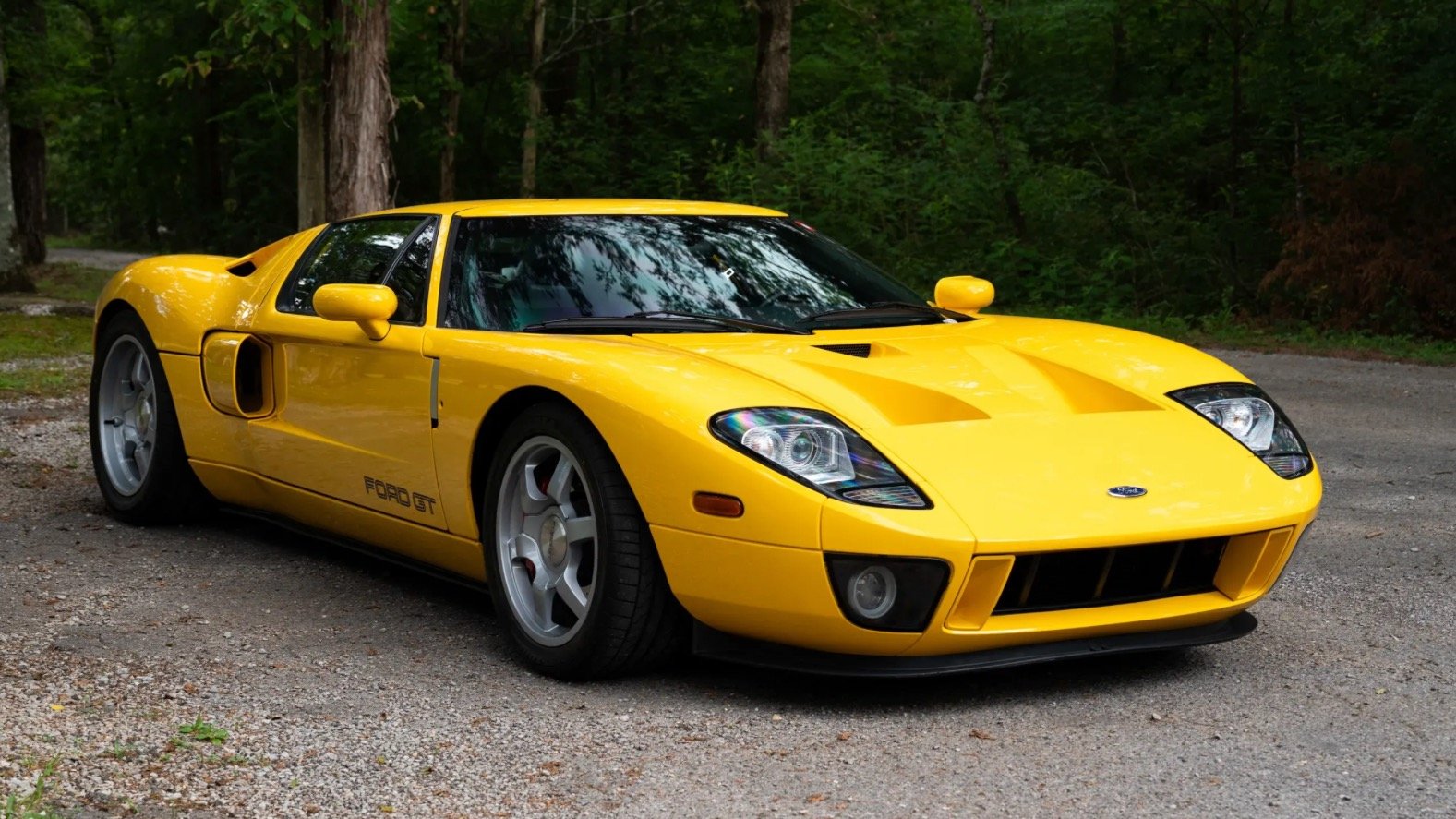


Only two 2006 Ford GTs rolled out of the Wixom Assembly Plant in Speed Yellow without racing stripes. One of them is now up for auction through DuPont Registry, and it looks almost naked.
That’s the thing about the first-generation Ford GT. The stripes weren’t just decorative — they were identity. The car debuted at the 2002 Detroit Auto Show wearing yellow paint with black stripes, a deliberate callback to the GT40 that humiliated Ferrari at Le Mans.
Nearly every buyer who wrote a check for one ordered the stripes as a matter of course. Choosing to delete them was an act of quiet defiance.
This particular car sits in Tennessee with 8,734 miles on the odometer, a black leather interior, and red brake calipers — the factory option that most owners ticked. It was originally sold by Davies Ford in Connellsville, Pennsylvania, and has passed through three private owners across Florida, Oklahoma, Texas, and Colorado. A well-traveled machine, but not a well-worn one.
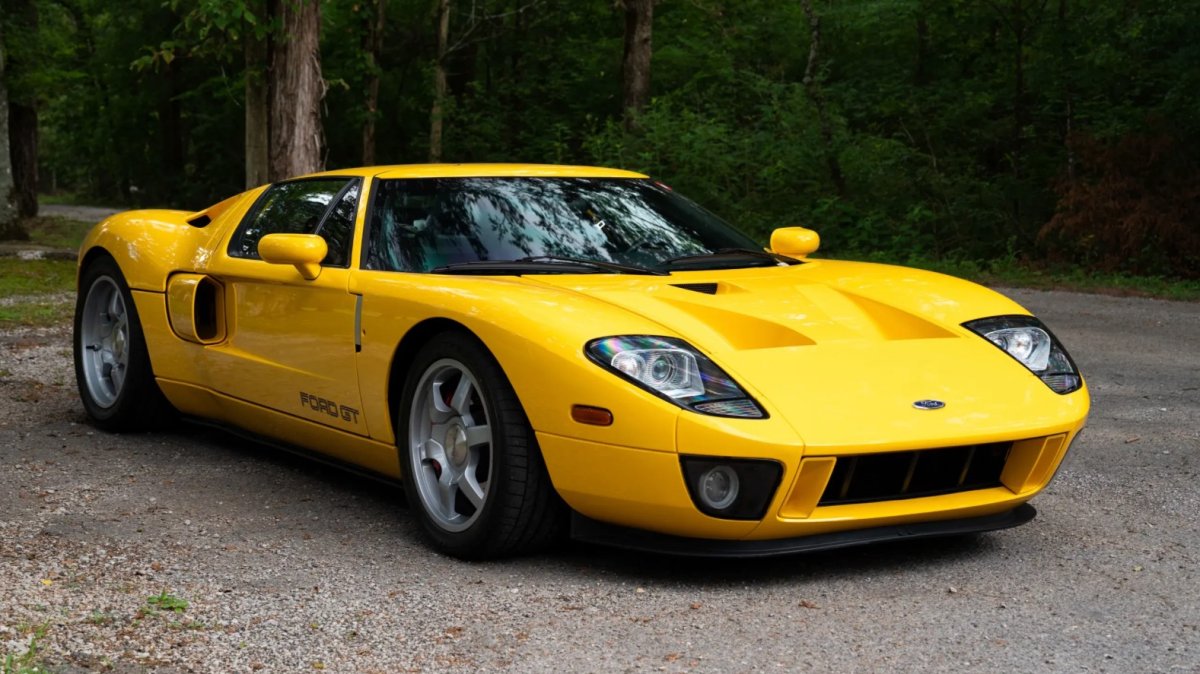
Underneath the contentious skin, the mechanicals remain as Ford intended. The supercharged 5.4-liter V8 makes 550 horsepower and 500 pound-feet of torque, routed through a six-speed manual gearbox. Ford claimed a 3.3-second sprint to 60 mph and a 205-mph top speed, numbers that still command respect two decades later.
The bespoke aluminum spaceframe chassis was serious engineering wrapped in nostalgia, a car that punched well above what most people expected from Dearborn at the time.
Ford built just 4,038 examples across the 2005 and 2006 model years, with actual production running from 2004 through 2006. The company vetted buyers carefully, a practice it would refine — some would say weaponize — when the second-generation GT arrived roughly ten years later with its application process and binding usage agreements.
The two cars couldn’t be more philosophically different. The first GT was a love letter to the past, shaped by emotion and powered by a big American V8 with a blower on top. The second GT was a calculated exercise in aerodynamics and turbo V6 efficiency, designed first to win the 2016 Le Mans 24 Hours on the 50th anniversary of Ford’s original triumph, and second to sell to civilians.
It delivered the class victory and the PR headline. Whether it delivered the same gut-level thrill is a conversation that still starts arguments at car shows.
This stripeless example sits at an interesting intersection of rarity and taste. Two-of-two production numbers tend to light up collector radars, but the absence of stripes on a Ford GT is genuinely polarizing. Some will see it as a cleaner, more elegant interpretation. Others will feel like something fundamental is missing — like a Shelby Cobra without side pipes.
The auction doesn’t list a reserve or expected hammer price, but context helps frame expectations. Clean, low-mileage first-generation GTs have been trading in the $350,000 to $500,000 range in recent years, with exceptionally rare examples pushing higher. A one-of-two configuration could command a premium, assuming the right buyer values subtlety over tradition.
Ford never officially raced the first-generation GT road car, though a handful were converted for competition duty. The irony is that this stripeless yellow example, born without the visual language of racing, might be the purest expression of what the car actually was — a street machine wearing a costume. Removing the stripes just made the costume honest.



Share this Story