
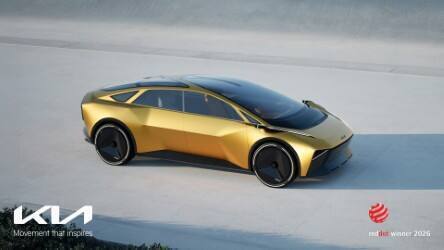


Kia’s Vision Meta Turismo just picked up a Red Dot Award 2026 in the Design Concept category for Cars and Motorcycles. That’s nice. What’s more interesting is the pattern it extends.
The EV6 won Best of the Best in 2022. The EV9 in 2024. The EV3 in 2025. The EV4 in 2026. The PV5 WKNDR Concept grabbed Best of the Best last year too, while four other Kia concepts took Winner honors in the same cycle. At some point, a streak stops being luck and starts being infrastructure.
The Vision Meta Turismo debuted at Milan Design Week, not at an auto show. That choice alone tells you where Kia thinks its competition lives. The concept is a grand tourer reimagined for an electric, digitally saturated future, with cab-forward proportions, a lounge-style passenger cabin, and three configurable driving modes called Speedster, Dreamer, and Gamer. The names sound like a PlayStation menu, and that’s probably the point.
Karim Habib, Kia’s global design chief, called the concept “an opportunity for us to experiment, challenge ourselves, and imagine future user experiences through design.” Translation: this car exists to stretch the brand’s visual language far enough that when the production models arrive, they look restrained by comparison. It’s the oldest trick in automotive design, and Kia executes it better than most right now.
The interior splits the cabin into two zones. The driver gets a focused cockpit built around control and immersion. Passengers get augmented reality content piped through a 3D heads-up display and something Kia calls the Add-Gear modular interface, which blends physical controls with digital overlays.
Whether any of this makes it into a showroom car is beside the point. The Red Dot jury evaluates the idea, not the bill of materials.
And that’s where Kia’s strategy gets clever. Concept awards are cheap marketing with expensive implications. Every Red Dot, every iF Design trophy, every best-in-show nod builds a perception layer that takes competitors years to replicate.
Hyundai Motor Group spent the better part of a decade recruiting talent from Audi, BMW, and Bentley to rebuild its design credibility. Habib himself came from BMW via Infiniti. The investment is paying compound interest.
Ten years ago, suggesting that Kia would dominate international design competitions would have gotten you laughed out of any press room in Detroit or Munich. The brand sold cheap transportation with forgettable styling. Peter Schreyer started changing that trajectory, and Habib is accelerating it.
The Vision Meta Turismo, with its soft geometric surface language and extreme cab-forward architecture, reads like a thesis statement from a design department that knows exactly where it’s going and isn’t waiting for permission.
Red Dot’s Design Concept award has existed since 2005, built specifically to recognize ideas before they become products. Kia keeps showing up with concepts that push harder than its production lineup would suggest, then slowly closes the gap. The EV6 started as a concept that felt like a reach, and it became Car of the Year in multiple markets.
The Vision Meta Turismo won’t be built as shown. Nobody’s getting a Gamer mode in their Kia sedan anytime soon. But the sculptural language, the spatial thinking, the interface philosophy — pieces of this will surface in production vehicles within three to five years. They always do.
Kia isn’t collecting design awards for the trophy case. It’s using them to rewrite the hierarchy, one jury at a time. The brands that once owned the design conversation are now competing against a Korean automaker that treats concept cars like cultural artifacts and auto shows like afterthoughts. Milan Design Week over Geneva. Red Dot over horsepower claims. The game changed, and Kia changed it.


Share this Story