
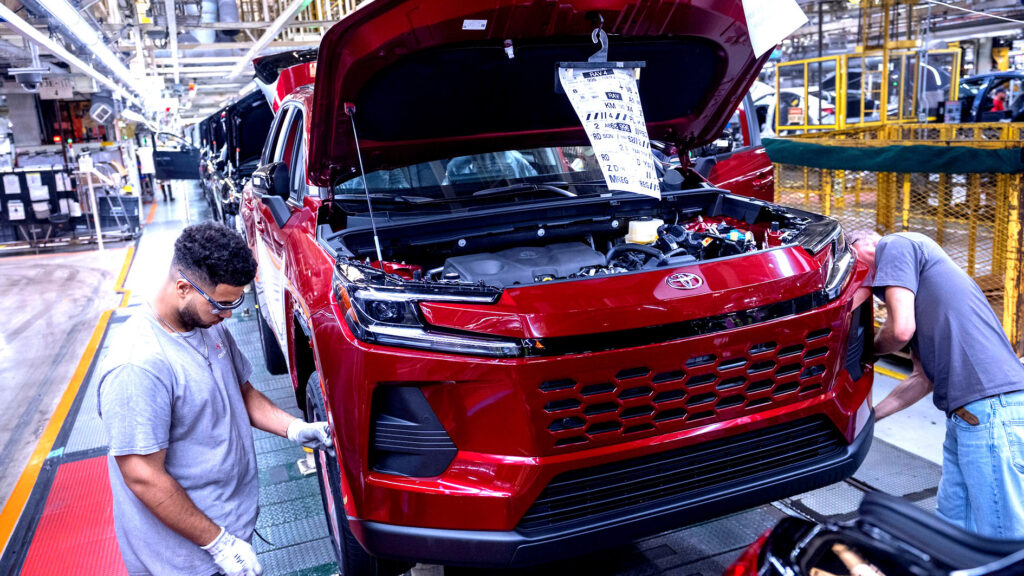


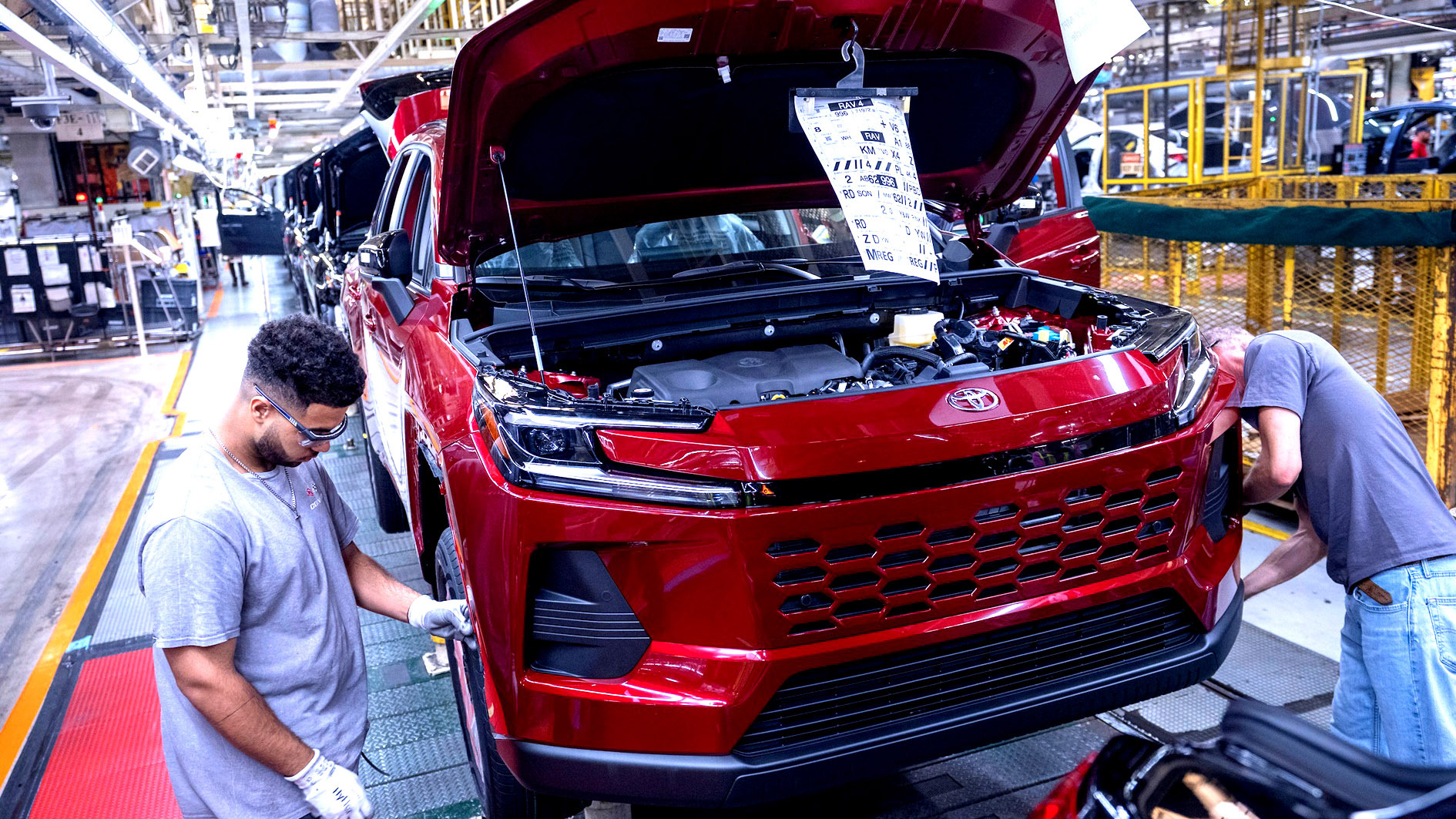
Toyota’s overseas production cuts just got worse. What started as an 83,000-unit pullback triggered by instability around the Strait of Hormuz has now ballooned to roughly 100,000 vehicles slashed through February 2027. The company’s single most important nameplate — the all-new RAV4 — sits squarely in the crosshairs.
The world’s largest automaker confirmed it will reduce production of standard combustion-engine RAV4 models built outside Japan. This comes barely weeks after Toyota resumed hybrid RAV4 production at its Georgetown, Kentucky plant following retooling delays that had already choked supply. The company previously estimated those disruptions alone would cost it 55,000 RAV4 sales in the U.S. this year.
Now stack the overseas cuts on top of that.
Toyota didn’t specify how many fewer RAV4s will roll off international assembly lines, but it did announce a modest countermeasure. Japanese production of the RAV4 and Land Cruiser 250 will increase by 4,200 units in the second half of the fiscal year. That’s a rounding error against a 100,000-unit hole.
The timing is brutal. Dealers across the United States report RAV4 demand so intense they’ve stopped measuring inventory in days’ supply and started counting in hours. Some stores have hundreds of customers on wait lists. The new-generation RAV4 has landed as a genuine hit, and Toyota cannot build enough of them.
Every unit cut from the schedule is a sale that walks — possibly to a competitor’s showroom.
Suppressed demand in the Middle East, North Africa, and parts of East Asia is the stated reason for the broader pullback. High fuel prices across those regions have cooled new-vehicle appetite, and Toyota has told key suppliers to plan accordingly. That’s corporate speak for: don’t expect this to reverse quickly.
China is another pressure point entirely. Toyota’s latest electric vehicles — the bZ3X, bZ7, and Chinese-market Camry — are all facing production reductions. The company’s EV push in China has failed to dent the dominance of BYD, Nio, and Xiaomi.
Local buyers have moved on. Toyota is being forced to reset its ambitions in the world’s largest auto market, a painful acknowledgment for a company that once treated China as a growth engine.
The pattern here is unmistakable. Toyota’s global production network is being squeezed from multiple directions at once — geopolitical risk choking Middle Eastern shipping lanes, a stalled EV strategy in China, and retooling hiccups in North America. The RAV4 shortfall is the most commercially damaging of these problems because it’s happening in a market where buyers are lined up with checkbooks open.
Toyota has navigated supply crunches before. It famously weathered the post-COVID semiconductor crisis better than most rivals, thanks to deep supplier relationships and strategic inventory buffers. But this is different.
The current squeeze isn’t a single-cause disruption with a clear end date. It’s a convergence of structural problems across multiple regions.
For American buyers camping on dealer wait lists, the math is simple and unforgiving. Toyota is adding 4,200 units of combined RAV4 and Land Cruiser production in Japan while cutting 100,000 units overseas. The new RAV4 remains one of the best compact SUVs on sale. And getting one just got harder.
Share this Story