
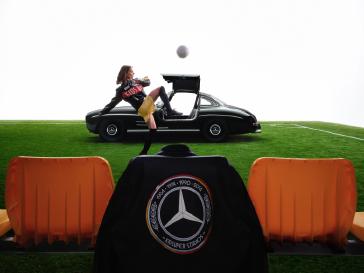


A 1928 SSK paired with Uruguay. A 300 SL Coupé matched to Germany’s 1954 triumph. A G 500 assigned to France’s 1998 squad. Mercedes-Benz just turned seven of its most iconic vehicles into fashion accessories, and the runway was in Miami, not Paris.
The collaboration with KidSuper — the streetwear-meets-tailoring label run by Brooklyn’s Colm Dillane — debuted June 25 with a runway show that paired historic Mercedes models with handcrafted fashion pieces, each representing a World Cup-winning nation. It marks KidSuper’s first major collection show outside Paris Fashion Week. It also marks Mercedes-Benz’s latest and most aggressive push into the lifestyle brand space.
The concept is simple enough. Seven nations have stars on their jerseys. Mercedes-Benz pulled a vehicle from its archives corresponding to each country’s greatest soccer moment.
Brazil’s 1958 win gets a 220 SE. Argentina’s 1978 victory draws the land-yacht 450 SEL 6.9. England’s lone 1966 title pairs with the imperious 600 Grosser. Spain’s 2010 campaign gets the SLS AMG Coupé Electric Drive Concept — a car that, like Spain’s tiki-taka era, was technically brilliant but never quite made it to mass production.
Each car-country pairing gets a limited-edition KidSuper garment — tailored pieces, leisurewear, accessories — featuring custom patches and embroidery that reference both the vehicle and the nation. The capsule collection drops this fall.
Dillane is an interesting choice for Stuttgart. He’s not a car designer. He’s a 31-year-old who built KidSuper out of a Brooklyn storefront, became a fixture at Paris Fashion Week, and operates in the space where fashion, soccer fandom, and internet culture collide.
His aesthetic is playful and deliberately imprecise — hand-painted fabrics, oversized silhouettes, storytelling stitched into every seam. It’s about as far from German engineering precision as you can get, which is probably the point.
Mercedes-Benz has been on this trajectory for a while now. Partnerships with Roger Federer. Collaborations across music, art, and design. The brand’s 140th anniversary campaign — currently driving three S-Classes to 140 locations across six continents — is less about horsepower than about heritage as cultural currency.
The Miami show, livestreamed globally, drew guests from fashion, sports, music, and entertainment. Not a single powertrain specification was discussed.
This is a company that sells 18 model lines in the U.S. market, from the GLA to the S-Class to its expanding electric lineup, and its marketing strategy increasingly has nothing to do with any of them. The vehicles at the KidSuper show weren’t for sale. They were props — gorgeous, irreplaceable, museum-grade props — in a brand narrative being written for people who might not buy a Mercedes for another decade, if ever.
There’s a logic to it. Luxury automakers are fighting for relevance among younger consumers who care more about cultural fluency than torque curves. Ferrari has Puma. BMW has fashion collabs of its own.
Mercedes-Benz is betting that a Brooklyn designer with a soccer obsession and a sewing machine can do what a Super Bowl ad cannot: make the three-pointed star feel alive to a generation that streams everything and owns very little.
Whether a limited-edition patch jacket moves the needle on S-Class deposits is unknowable and probably irrelevant. The game Mercedes is playing is longer than that. They’re spending real money — pulling a real SSK out of storage, flying it to Miami, and letting a fashion designer build a story around it — because they believe brand heat is the new horsepower.
The capsule collection arrives this fall. The cars go back to the vault. The bet is that the feeling lingers.
Share this Story