
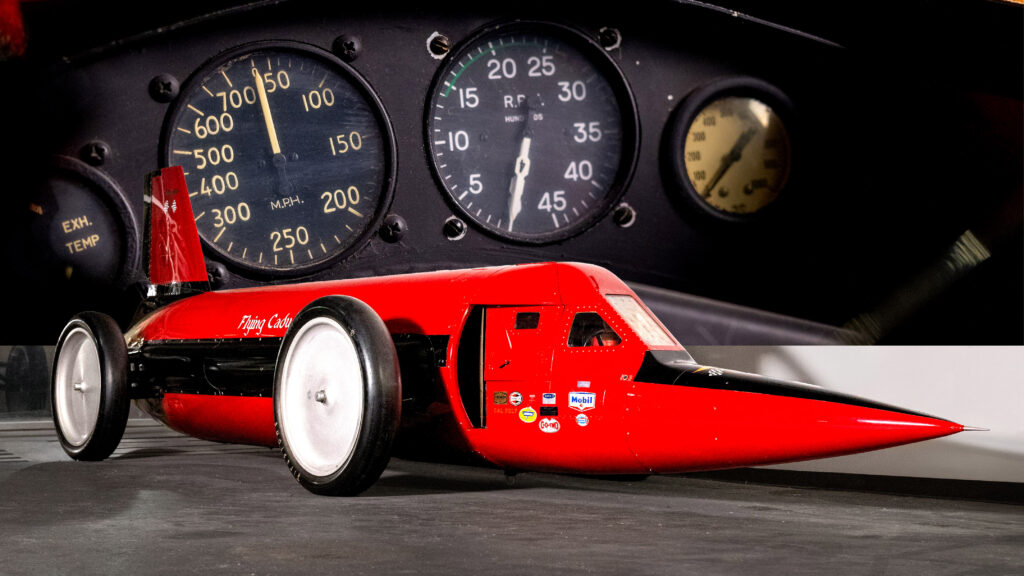


The Flying Caduceus was supposed to sell this month for somewhere between $70,000 and $90,000. That’s less than a loaded pickup truck. Instead, the lot was quietly withdrawn from Bonhams’ National Automobile Museum Auction in Reno, and nobody is saying why.
For a machine that essentially invented jet-powered land speed racing, the silence is deafening.
Dr. Nathan Ostich built this thing in the late 1950s, when piston engines were still the currency of speed records and strapping a military turbojet to a wheeled chassis sounded like science fiction or suicide. He did it anyway. The power source was a General Electric J47-19, originally designed to supplement the six radial piston engines on the Convair B-36 Peacemaker, America’s primary nuclear bomber of the early Cold War.
One of those turbojets produced 5,200 pounds of thrust, roughly 6,930 horsepower, and Ostich mounted it inside a four-foot-diameter tubular steel frame wrapped in hand-formed aluminum. The speedometer was marked past 700 mph. The ambition was not subtle.
But the engine was never the hard part. Tires were. At 500-plus mph, conventional rubber would have simply exploded under centrifugal force.
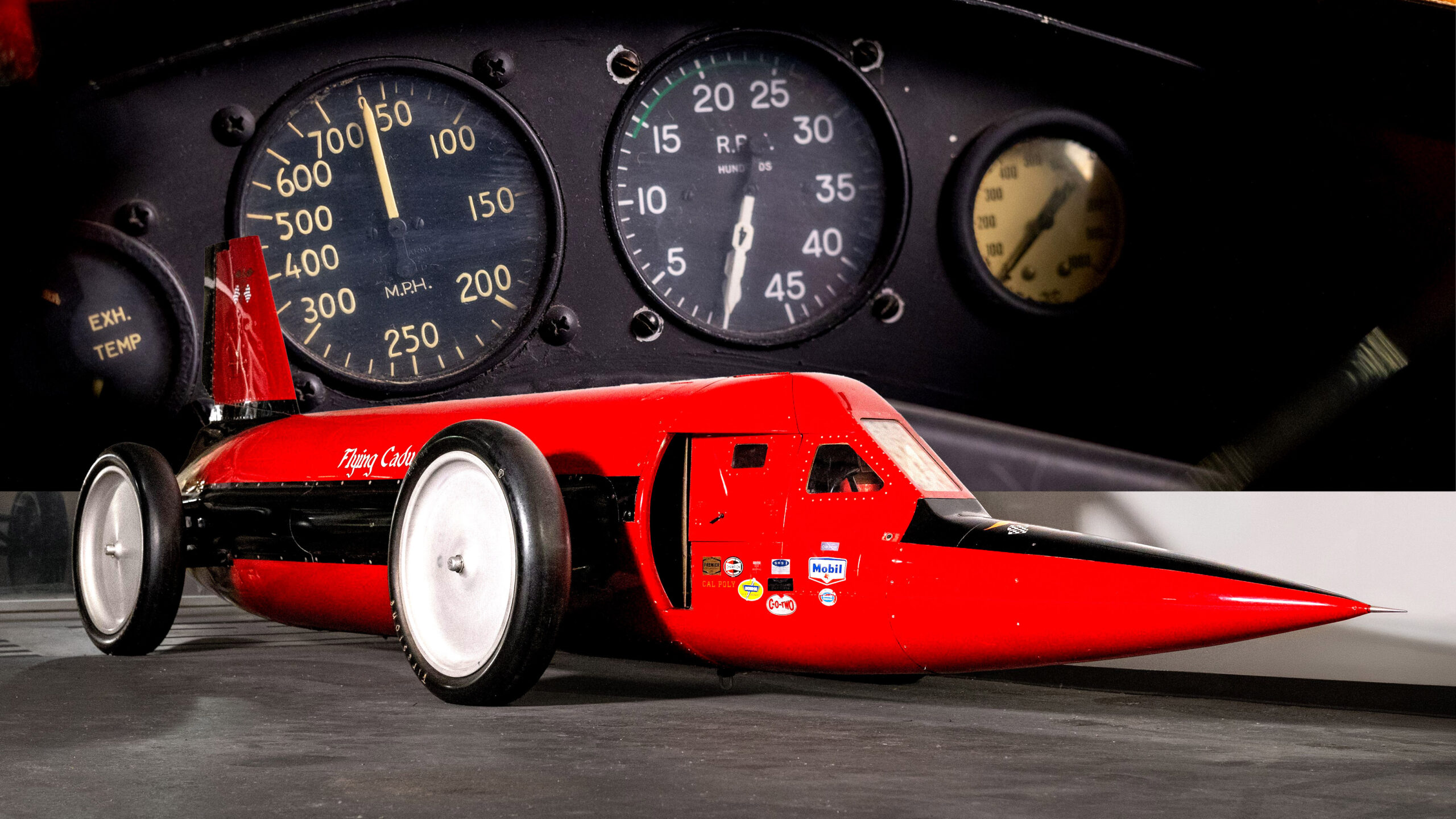
Firestone stepped in to develop a bespoke wheel-and-tire package that could survive the physics involved, a collaboration that itself pushed the boundaries of materials science. The rest of the car featured four-wheel independent suspension, disc brakes, and an eight-foot drag parachute. Systems that seem obvious now but were anything but in 1960.
The Flying Caduceus topped out at 359.7 mph during testing on the Bonneville Salt Flats. It never hit 500. By the narrow scorekeeping of record books, it failed, but by every other measure, it rewrote the rules.
Craig Breedlove’s Spirit of America, the car that broke the 400, 500, and 600 mph barriers, followed directly in Ostich’s conceptual wake. So did Richard Noble’s Thrust2 and eventually Andy Green’s Thrust SSC, which set the current land speed record at 763 mph in 1997. Every jet-powered land speed car that came after owes a debt to the machine a doctor from Los Angeles built because he believed wheels could carry a jet engine faster than anyone had gone before.
And someone was about to sell it for the price of a mid-spec SUV.
The $70,000 to $90,000 estimate tells you something uncomfortable about how the collector market values engineering significance versus brand cachet. A numbers-matching Hemi ‘Cuda will fetch seven figures without breaking a sweat. The car that proved jet propulsion could work on land, that opened the door to every supersonic vehicle program that followed, was listed without reserve below six figures.
Now it has vanished from the sale entirely. Bonhams has not disclosed whether the consignor pulled it, whether a pre-auction private deal was struck, or whether some other circumstance intervened. The auction house’s listing simply reads “withdrawn.”
There are two ways to read this. Either someone recognized the absurdity of the estimate and decided to keep it, or the car slipped quietly into private hands where it may not surface again for years. Neither outcome changes the fundamental problem: the market has no idea how to price a machine whose value is measured in influence rather than displacement or provenance.
The Flying Caduceus deserves a museum with a plaque that explains what it made possible. Whether it gets one is another question entirely.





Share this Story