
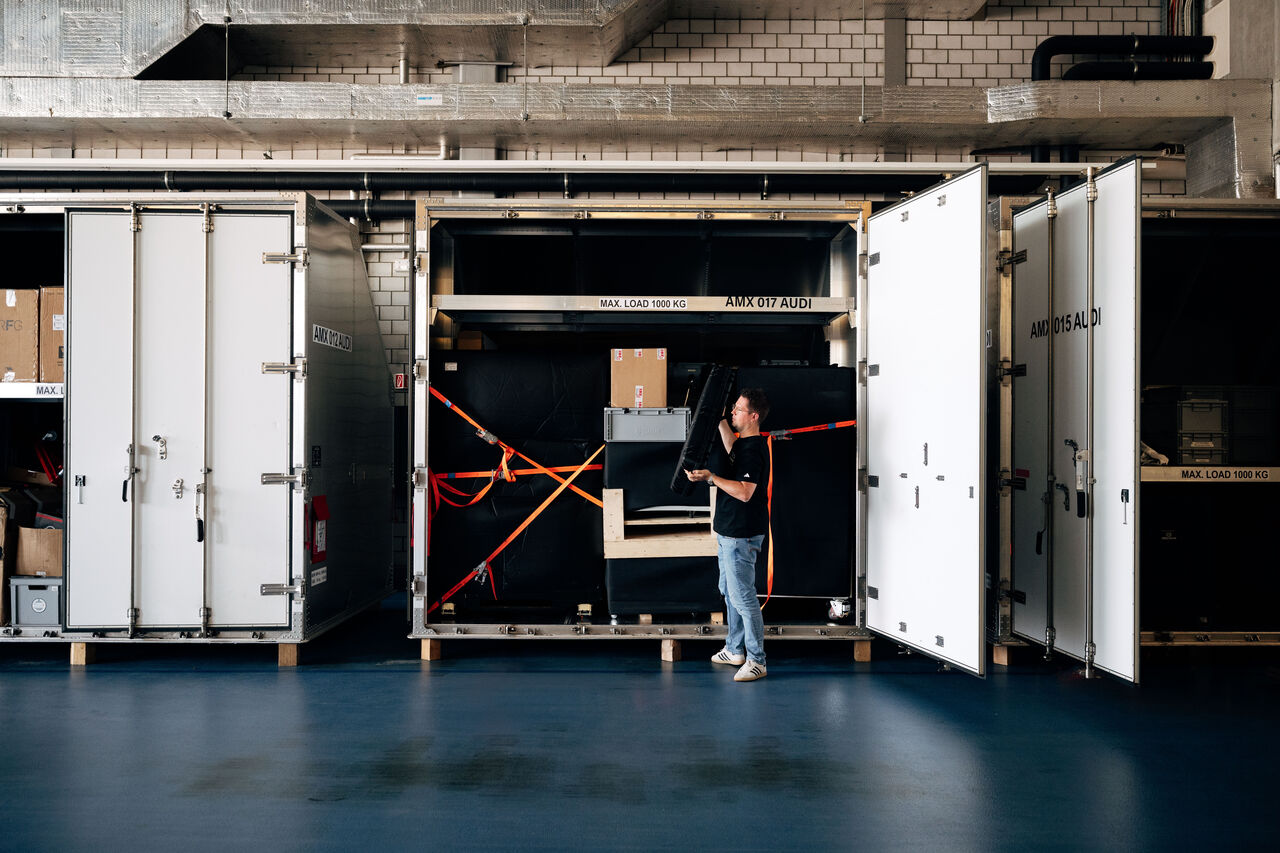


A supplementary shipment for Audi Revolut F1 Team’s debut race in Melbourne got stranded when global air traffic restrictions kicked in mid-route between Zurich and Dubai. Critical update parts sat in limbo. The team scrambled an alternative route through F1 Cargo and DHL, rewrote customs documents on the fly, and landed the freight on Wednesday evening, just hours before the cars needed to be fully assembled for Thursday’s first session.
Both cars made it out. Audi scored points in its very first grand prix.
That story, told by Björn Brickwedde, Head of Logistics at Audi’s Hinwil-based F1 operation, is the kind of thing that keeps logistics people up at night and makes them feel alive in the morning. It also mirrors a crisis Audi’s road-car supply chain navigated not long ago.
During production of the final batch of Q2s, a container carrying irreplaceable display units was en route from China through Dubai when conflict erupted in the Middle East. The shipping company unloaded everything at an Indian port without notice. Audi rerouted through Sri Lanka and Turkey.
The displays arrived half a day before the production line needed them. Without that save, 2,000 cars would never have been finished.
Dieter Braun, who runs Audi’s entire supply chain, orchestrating thousands of suppliers across nearly 60 countries and roughly a million parts per day, uses the R26 race car as his permanent video-call background. It’s not decoration. It’s a message to his organization: speed kills hesitation.
“If there’s one thing we need in the company, it’s speed,” Braun says. “Not just on the racetrack, but when making decisions.”
The parallels between Formula 1 logistics and mass automotive production are less metaphorical than they sound. Both operate under crushing time constraints, geopolitical volatility, and zero tolerance for failure. The difference is scale and visibility.
When an F1 team botches a pit stop, 500 million viewers see it. When a supplier shipment goes sideways, the damage shows up in quarterly earnings six months later.
Under F1’s cost cap, every dollar saved on freight is a dollar that goes into development and ultimately into lap time. Brickwedde’s team carries only what they expect to need at each race. When something unexpected breaks, improvisation rules.
A team member might literally carry rear wing components in their luggage to get them trackside fast enough.
Lars Rolack, who leads logistics at Audi Formula Racing’s power unit facility in Neuburg, lived through both worlds. He came from Audi’s production logistics before joining the F1 project. In Neuburg, his team turned around an unscheduled high-voltage battery return during the Miami race weekend, handling hazardous materials, special customs clearance, technical analysis, and reshipment to Montreal, in less than 72 hours.
“My background in planning helped me,” Rolack says, “but race logistics is a very ad-hoc business. We all had to adapt our mindset extremely quickly.”
The knowledge transfer runs both directions. Audi’s supply chain division is pushing AI into forecasting, ramp-up planning, and sequencing optimization. The F1 team, leaner and more reactive, still relies heavily on phone calls and personal networks.
Braun sees potential everywhere but cautions against blind trust: “I would never let AI design my entire network without critically questioning it.”
There’s a deeper organizational lesson Audi extracted from COVID and now reinforces through F1 exposure. Resilience isn’t one thing. It’s organizational structure, team cohesion, and individual grit layered together.
Race weekends stress-test all three simultaneously, in public, with no margin for error.
Braun’s sharpest observation cuts through the corporate fog: “Some decisions don’t get any better if you put them off longer.” Formula 1 proves that every two weeks. Whether Audi’s road-car bureaucracy can actually absorb that lesson, rather than just admire it on a screensaver, will determine how much this billion-dollar motorsport investment pays off beyond the podium.






Share this Story