
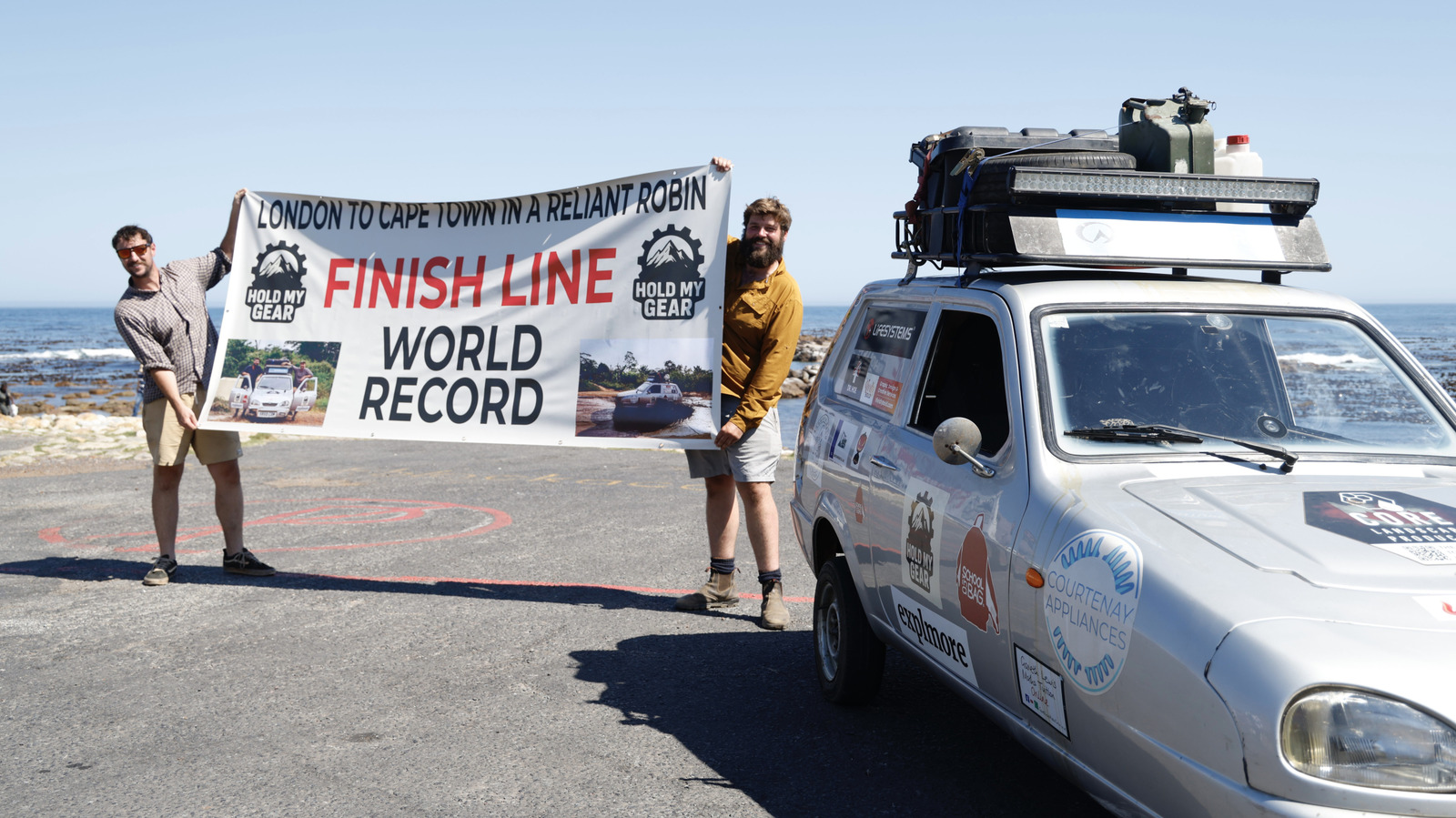


A decades-old Reliant Robin — a car whose own designer is afraid to drive it more than 20 miles — rattled into Cape Town, South Africa, last month after 14,000 miles, 22 countries, and four and a half months of pure mechanical defiance. The engine was badly overheating. It had been touch and go for the final thousand miles. The car made it anyway.
Ollie Jenks, an Englishman, and Seth Scott, a Canadian, are the two responsible. They operate under the name Hold My Gear, and Scott dreamed up the scheme: buy one of the last Reliant Robins ever built, strap a can of fuel and some supplies to its tiny roof, and drive it from London to the southern tip of Africa to set the record for the longest journey in a three-wheeled vehicle.
“It was so ridiculous I couldn’t say no,” Jenks told the AP.
The previous record belonged to Anton Gonnissen, who retraced the Peking-to-Paris route on a three-wheeled motorcycle in 2019. Jenks and Scott didn’t just want to beat it. They wanted to obliterate it in the least capable vehicle imaginable.
No power steering. No air conditioning. A 30-liter fuel tank. Seats swapped from a used Mazda MX-5 because the originals felt like golf cart furniture. The prep work was less “expedition build” and more “desperate triage on a car that was already half-rusted.
Problems started on day one. The suspension sagged under the weight of their gear. Day two, the rear window began falling out. By mid-first-week, leaving Le Mans, the engine misfired.
They nearly got deported from Morocco over a car insurance issue. They had 5,000 miles and 24 days to reach Ghana before their visas expired.
It only got worse. The gearbox grenaded in Ghana, leaving them stuck in fourth gear. A stranger got a replacement shipped in.
The clutch failed in Cameroon. Then the distributor. Then the engine blew entirely. Reliant enthusiasts back in the UK sourced a replacement motor and sent it to Central Africa. Mechanics across the continent welded, hammered, and shook their heads.
Between breakdowns, the geopolitics were no kinder. They arrived in Benin during an attempted coup. They passed through northern Nigeria while the U.S. was launching airstrikes on Islamic State targets.
In Cameroon, the Robin joined a military convoy for 300 miles through the Anglophone Crisis war zone. An overtaking bus in Congo nearly crushed them against a cliff face.
“Imagine this car in a military convoy,” Jenks said.
At one point a man with a shotgun slung at his side helped push the dead Robin back to a hotel. Another time locals loaded the car onto a cattle truck to haul it to a garage. The kindness of strangers kept the journey alive as much as any wrench did.
The whole thing cost between $40,000 and $50,000, funded partly by sponsors and crowdfunding. Their Instagram page — tagline: “14,000 miles, 3 wheels, 0 common sense” — pulled nearly 100,000 followers.
And then there were the moments that made it all absurd in a different way. The Robin cruised alongside galloping giraffes. It posed next to elephants.
It spotted endangered rhinos. Jenks got recruited to help fishermen on the coast of Ghana. A car designed to fetch groceries in 1970s Britain went on safari.
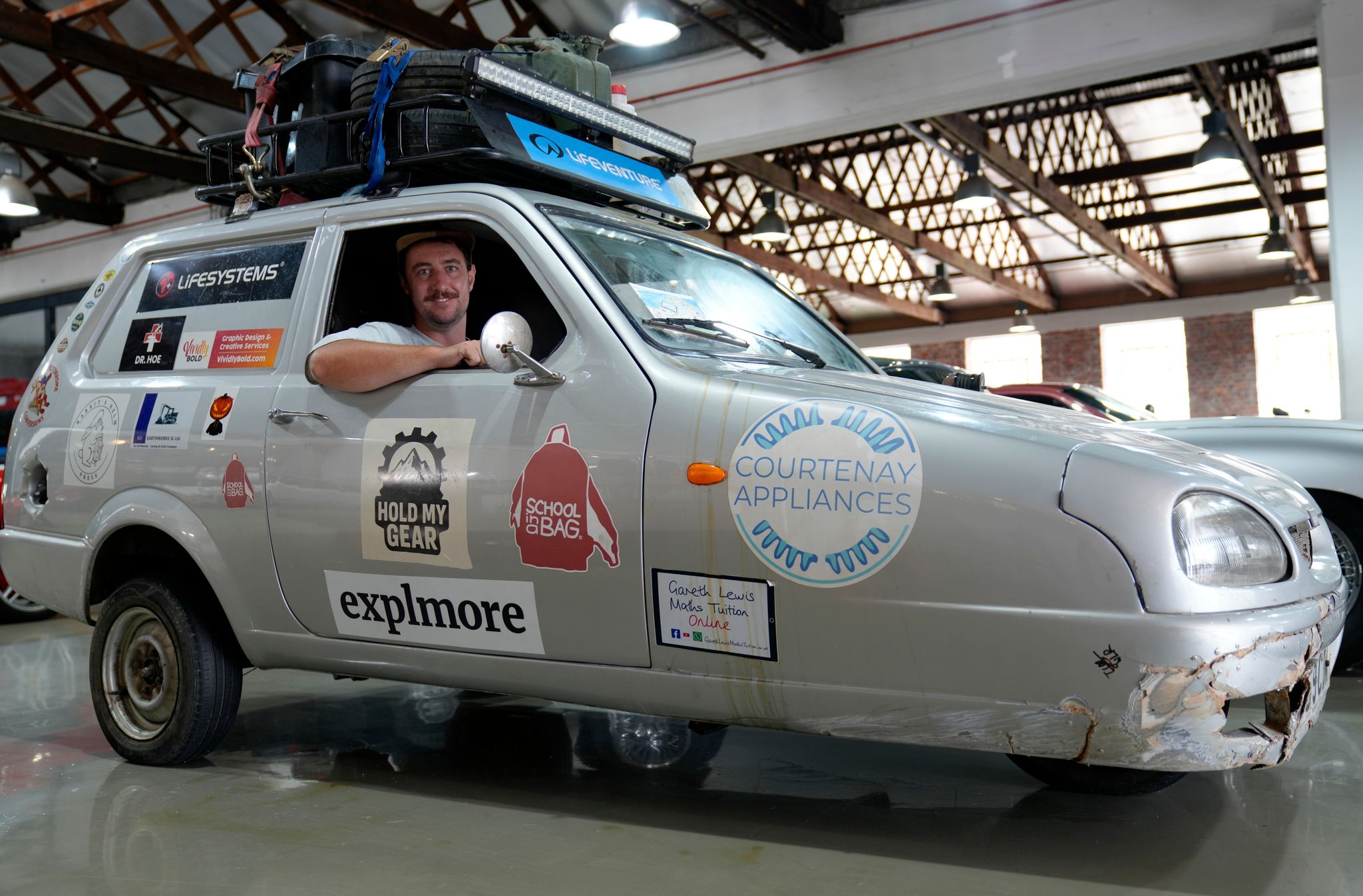
In Cape Town, Sheila was displayed in a high-end showroom alongside Porsches and Mercedes. She upstaged every one of them — broken side window, gas-stained windshield, bent rims, and all.
Graeme Hurst, a South African car enthusiast who came to see the Robin in person, called it “a great underdog story” marked by “utter tenacity.”
Jenks described the experience differently. “It was like driving a motorized coffin.”
Asked if he’d do it again: “Absolutely f***ing not.”
Sheila isn’t quite done yet. She’ll be driven to Kenya, shipped to Turkey, and returned to the UK for a permanent home at the London Transport Museum. A fitting retirement for a car that had no business surviving any of this.

Share this Story