
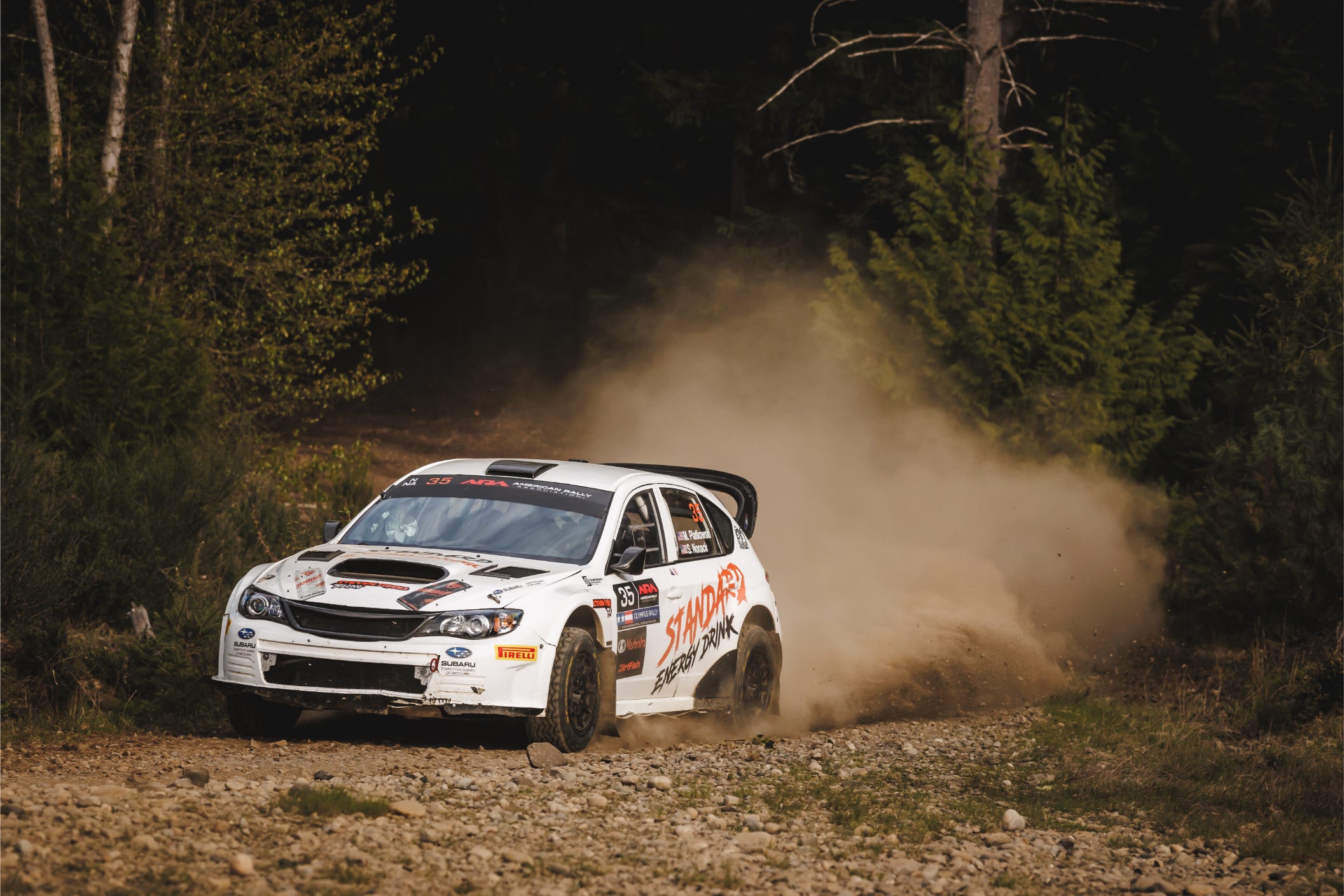


Mark Piatkowski showed up to the 2026 Olympus Rally in a borrowed 2011 Subaru WRX STI with a naturally aspirated flat-six under the hood and 245 horsepower on tap. He left three days later with a seventh-place overall finish, a class win, and a lot of confused spectators who swore they heard a Porsche coming through the trees.
They weren’t entirely wrong about the sound. The EZ30 flat-six that Steven Redd Racing shoehorned into the STI hatchback produces an uncanny wail, close enough to a 911 GT3 RS that it became a running joke in the service park. But nobody was laughing at the time sheets.
Piatkowski and co-driver Sara Nonack completed over 200 stage miles across Washington’s Olympic Peninsula, at times posting stage times that beat factory-supported Rally2 machines from Hyundai and Toyota. Those cars make roughly 300 horsepower and run purpose-built suspension, brakes, and drivetrain components engineered for stage rally. The Subaru runs a stock engine.
The American Rally Association’s 2026 grid is the deepest it has ever been. Hyundai fields homologated i20 Rally2 cars. Toyota brought a GR Corolla Rally2. Subaru backs Travis Pastrana in a factory-derived ARA25L. These are serious machines with serious budgets. Piatkowski’s ride was on loan.
“It was just good to mix it up with cars that this car shouldn’t be really mixing up with,” Piatkowski told Road & Track. He didn’t ease into the event. “I don’t usually build up my pace. I just go really quick from the beginning, or at least try to.”
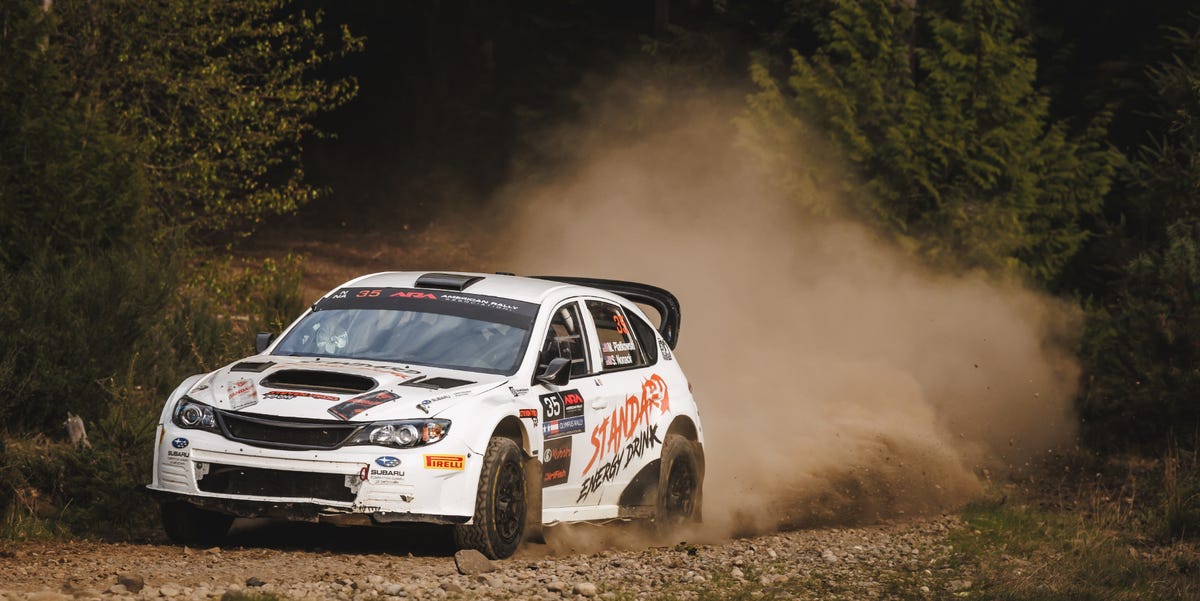
Quick is relative when the stages are punishing. The team hit boulders on the racing line five or six times hard enough to launch the nose of the car. They nursed two slow punctures without stopping to change tires. After the first nine-mile stage, Piatkowski told Nonack it felt “super long.” She laughed. The longest stage was 25 miles.
Piatkowski described the flat-six STI as a halfway point between a production car and a Rally2 machine. The seating position is set far back in the chassis, giving it Rally2-like dynamics. But it lacks the suspension sophistication and pitch control of those purpose-built cars. In the hands of a 16-year veteran who has raced Hyundai i20 VRTs in Lithuania, that gap apparently didn’t matter much.
This was Piatkowski’s first time driving the car at Olympus, his first time running the event at all, and only his second ARA round of the season. He won SnoDrift in February in a different car, which means he’s now two-for-two and sitting in a legitimate position for a national championship run.
He scraped together the effort the hard way. The New Jersey-based driver lined up sponsorships from Standard Energy Drunk, EJ’s Upcycle Garage, and Competition Subaru. Finding a competitive car was the harder problem, solved only by Steven Redd Racing’s willingness to lend theirs for the weekend.
That arrangement was temporary. Piatkowski says he has a quicker car inbound from Europe for the rest of the season — an open-class Subaru, which suggests something with considerably more firepower than 245 naturally aspirated horsepower.
The Olympus result is the kind of story that used to define rally’s appeal: a privateer in a misfit car, running on borrowed equipment and stubborn talent, hanging with the factory teams on raw pace. The fact that it happened in 2026, against the most professional ARA grid ever assembled, makes it land harder.
Rally has always rewarded the driver who could extract more from less. Piatkowski just proved that equation still works — even when the car sounds like it escaped from Stuttgart.
Share this Story