
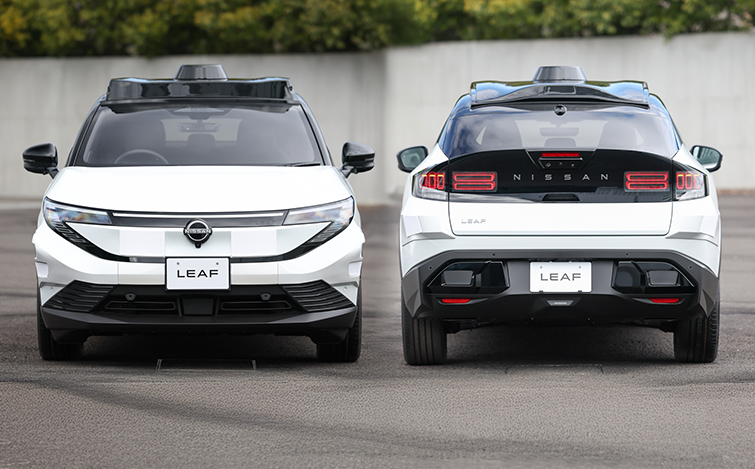


A Nissan LEAF with dual NVIDIA DRIVE AGX Thor processors, forward-facing LiDAR, and no need for HD maps will roll through the halls of NVIDIA GTC 2026 this week. It is the robotaxi prototype that Wayve, Nissan, and Uber intend to put on Tokyo streets by late this year.
The vehicle, revealed March 16, is the physical manifestation of a collaboration announced just four days earlier. Wayve provides the AI brain. Nissan provides the electrified body. Uber provides the passengers. And NVIDIA provides the computational backbone — its DRIVE Hyperion platform, designed specifically for Level 4 autonomy.
The combination is striking because of who it leaves out. Waymo, the longtime leader in autonomous ride-hailing, runs its own vertically integrated stack. Tesla is building its own robotaxi hardware from scratch.
Here, three companies with very different competencies are assembling a robotaxi from modular parts, betting that specialization and partnership can outrun the integrated approach.
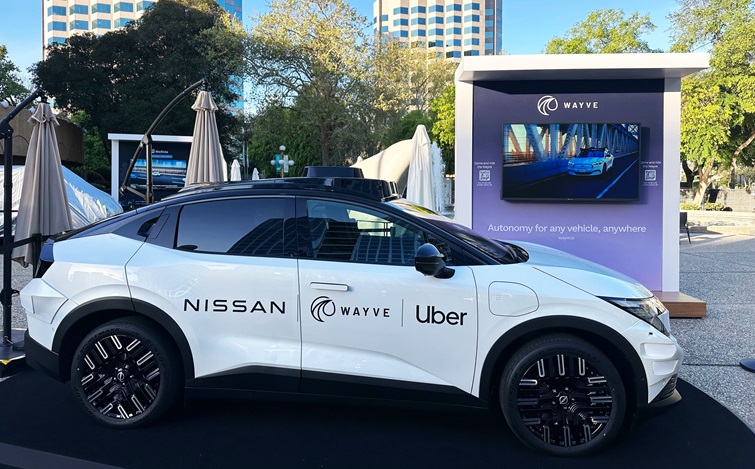
Wayve, a London-based startup that secured $1.5 billion in funding just weeks ago, has built its reputation on end-to-end embodied AI — a system that learns to drive from real-world data rather than relying on pre-mapped environments. The company says it has been testing in Japan since early 2025, accumulating experience with the country’s notoriously complex road layouts and dense urban traffic.
That mapless approach is the key selling point for global scale. HD maps are expensive to build and brutal to maintain. Every road change, every construction zone, every new intersection requires updates.
Wayve’s AI Driver skips that entirely, processing sensor data in real time to understand and react to traffic as it unfolds. The promise: drop the system into a new city and it adapts.
The prototype’s sensor suite backs up those ambitions. High-resolution cameras deliver 360-degree coverage. Surround and forward imaging radar handles detection in poor visibility. A forward-facing LiDAR adds depth perception.
Redundancy is baked into the hardware — Nissan is engineering fully redundant vehicle systems, a non-negotiable requirement for any car expected to operate without a human fallback. Underneath it all sit two NVIDIA DRIVE AGX Thor processors running NVIDIA DriveOS, wrapped in the company’s Halos framework for functional safety and cybersecurity. That is serious silicon for a compact EV most people associate with suburban commutes and quiet acceleration.
The Tokyo pilot will begin with safety operators behind the wheel, a standard industry precaution. Uber plans to run the service through a licensed local taxi partner, navigating Japan’s regulatory landscape with what CEO Dara Khosrowshahi described as “close alignment with relevant authorities.” That diplomatic phrasing hints at the real challenge — Japanese regulators have been methodical, not fast, in opening roads to autonomous vehicles.
Tokyo is also the first stop in a much larger plan. Wayve and Uber have publicly committed to expanding robotaxi trials across more than ten cities globally, including London. The goal is to graduate from supervised pilots to fully scalable, operator-free services.
For Nissan, the stakes extend beyond robotaxis. The automaker signed definitive agreements with Wayve in December 2025 to bring AI-driven assistance technology across its consumer lineup, with a next-generation ProPILOT system slated for launch by fiscal year 2027. The robotaxi work feeds directly into that pipeline — every mile of autonomous data collected in Tokyo sharpens the algorithms that will eventually land in cars regular people buy.
Nissan CEO Ivan Espinosa called it “the next chapter of mobility innovation.” Perhaps. But it is also a survival strategy for an automaker that has spent recent years restructuring and searching for a technological identity.
Hitching the LEAF — a pioneer that lost its shine — to a cutting-edge autonomy platform is a way to make the nameplate relevant again without designing a new vehicle from the ground up. Whether three companies can coordinate a robotaxi launch in one of the world’s most demanding driving environments by year’s end remains the open question. The prototype looks ready. Tokyo’s streets are another matter entirely.
Share this Story