
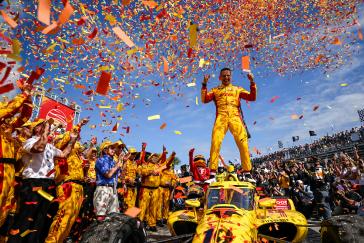


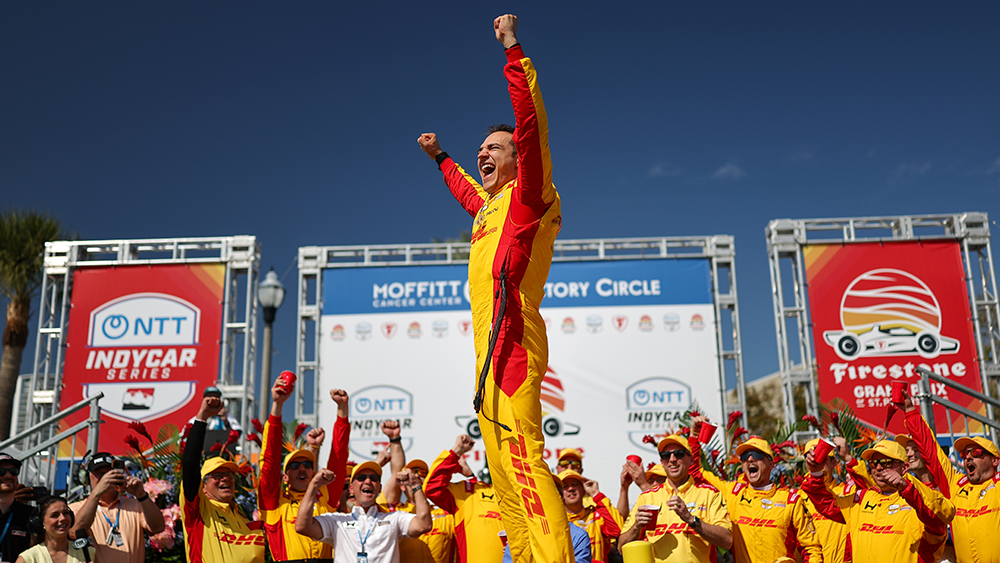
Twenty wins in 99 starts. Four championships in five years. Alex Palou has opened 2026 the same way he closed 2025 — by making the rest of the NTT IndyCar Series field look like they’re racing for second place.
The Chip Ganassi Racing driver won the Firestone Grand Prix of St. Petersburg by 12.4948 seconds over Scott McLaughlin’s Team Penske Chevrolet, the largest margin of victory in 23 editions of this event. That’s not a win. That’s a statement.
Palou started fourth and led 59 of 100 laps on the 1.8-mile street circuit, and the outcome was never seriously in doubt once strategist Barry Wanser played the decisive card on Lap 38. While McLaughlin and Marcus Ericsson had already pitted, Wanser held Palou out two laps longer on his alternate Firestones in a textbook overcut. Palou emerged in front and never looked back.
“This team keeps on improving, keeps on making new changes, and they just keep on raising the bar,” Palou said. “It’s a long season in front of us, but what a great way to start.”
The most telling detail came in the final stint. Palou switched to the harder, slower Firestone primary tires for his run to the checkers while both Kirkwood and McLaughlin took the grippier alternates. Kirkwood, who had been running second, never closed within 5.5 seconds. Palou then pulled away at a rate that made the tire disadvantage irrelevant.
This was the first race under IndyCar’s new mandate requiring at least two sets of alternate tires, a rule designed to shake up strategy and create more passing opportunities. Instead, it gave Palou and Wanser another variable to master — and they did, ruthlessly.
Kyle Kirkwood’s afternoon told a different story, the kind of gutsy drive that deserves more than a footnote. The Floridian started 15th in his Andretti Global Honda and sliced through traffic to run second for the majority of the final stint before tire degradation dropped him to fourth in the closing laps. McLaughlin and Christian Lundgaard both jumped him on Lap 94 with fresher rubber.
“We drove from 15th to fourth, which is a huge deal in the IndyCar Series,” Kirkwood said. “Everybody knows how hard that is to accomplish.”
Lundgaard’s rally from 12th to third gave Arrow McLaren two cars in the top five, with Pato O’Ward finishing fifth. McLaughlin’s runner-up result was respectable for Team Penske, though a 12-second gap to the winner takes some shine off it.
Among the rookies, Dale Coyne Racing’s Dennis Hauger qualified a stunning third and finished 10th — a solid debut. His more famous rookie counterpart, Mick Schumacher, lasted considerably less time. The Rahal Letterman Lanigan driver finished 25th after contact ended his afternoon early.
Scott Dixon, the ageless Ganassi legend, went off course and finished 23rd. Will Power retired from the race entirely.
Honda swept the top spot and placed five cars in the top 10. Chevrolet countered with McLaughlin’s second and O’Ward’s fifth, but the engine manufacturer battle looks lopsided early — largely because Palou is a Honda driver.
Last season, Palou won eight races and claimed the championship by 196 points, an advantage worth more than three full races. He won St. Pete and the Indianapolis 500. He turned a competitive series into a procession.
The field spent the winter trying to close the gap, and on the first Sunday of 2026, the answer came back: not yet.
The series moves to Phoenix Raceway on March 7 for the Good Ranchers 250, an oval race that pairs with a NASCAR Cup event in a doubleheader weekend. Different track, different discipline. But the man everyone has to beat remains the same.
Share this Story