
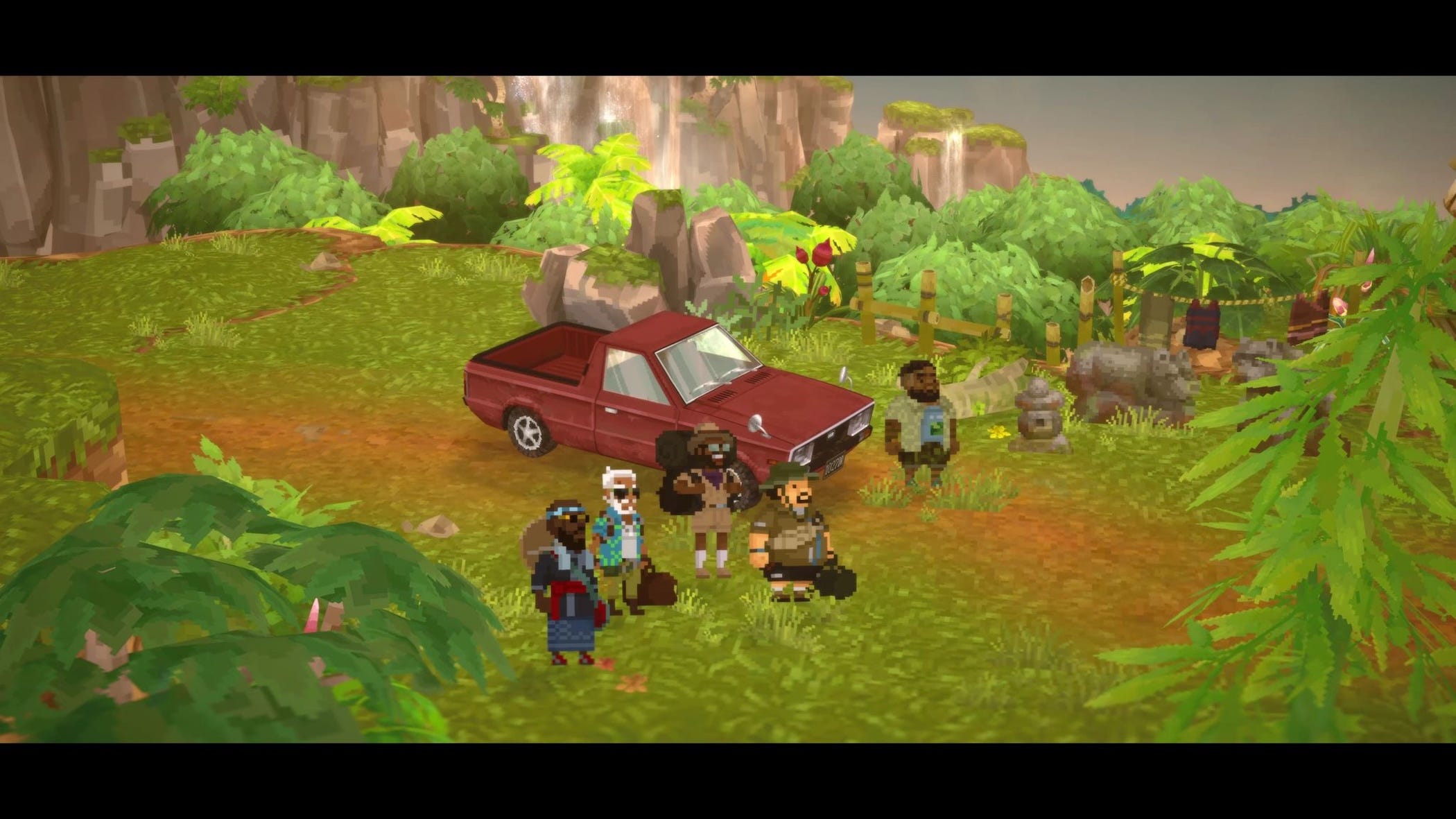


A battered red 1976 Hyundai Pony pickup is now a playable vehicle in one of the most successful indie video games of the decade, and somehow that’s more interesting than anything Hyundai’s current lineup is doing.
Dave the Diver, the retro-styled fishing-and-sushi-restaurant sim that moved 1 million copies in its first 10 days and has since landed in roughly 6 million households, just dropped its “In The Jungle” expansion pack. The star vehicle isn’t a sleek Ioniq 6 or a muscular Santa Cruz. It’s a 50-year-old car-based pickup that was never sold outside Korea and would lose a drag race to a riding lawnmower.
Hyundai officially partnered on the collaboration, which says something about how the automaker views its own heritage. The Pony was South Korea’s first mass-produced domestic vehicle, launched as a sedan in late 1975 and as a small pickup six months later. The factory that built it went from bare dirt to profitable production in under a year, a feat that still seems implausible even by Korean industrial standards.
In the game, the little red truck belongs to a local villager and serves as a fast-travel device. It also stars in a chase sequence where Dave and friends outrun an angry boar. There’s even an unlockable scale model for your in-game hut, earned by winning over grumpy NPCs. It’s deeply silly, and that’s exactly the point.
Automakers have been elbowing their way into gaming for years, but those partnerships almost always involve racing sims. Hyundai itself built a hydrogen-powered concept car a decade ago specifically for Gran Turismo. Putting a rusty old workhorse into a pixelated diving adventure is a different kind of bet entirely, one that trades horsepower bragging rights for genuine cultural affection.
The Pony earned that affection the hard way. In Korea, it occupies the same emotional space as the Volkswagen Beetle in Germany or the Citroën 2CV in France: a car that meant mobility for an entire generation. Its friendly face and utilitarian simplicity made it beloved on Korean roads for decades.
The story was less charming abroad. When Hyundai exported the second-generation Pony to Canada in the 1980s, buyers discovered a car that was perfectly adequate by 1975 standards but hopelessly outclassed next to a 1985 Honda Civic. Rear-wheel drive, modest power, and a body that rusted like it was being paid to dissolve earned Hyundai a reputation that took 20 years to shake.
That painful history makes this partnership sharper than it looks on the surface. Hyundai is now confident enough in its brand to celebrate the very vehicle that once symbolized its growing pains. The company that builds the Ioniq 5 and the 641-horsepower Ioniq 5 N is leaning into nostalgia for a truck that would have struggled to merge onto a highway.
Meanwhile, if you actually want a Hyundai pickup in the real world, your options are evaporating. The Santa Cruz is set to be discontinued after this model year with no announced replacement. The only Hyundai truck you can reliably get your hands on is now a collection of pixels in a game about catching fish and serving sushi.
There’s a lesson buried in the irony. Hyundai has poured billions into electrification, performance, and luxury positioning, yet the vehicle generating the most organic cultural goodwill right now is a half-century-old econobox with a bed bolted on. Renders of an Ioniq 5 pickup float around the internet regularly, and the demand clearly exists. Whether Hyundai reads the room or just keeps licensing the Pony for video games remains an open question.
For now, Dave’s got his truck, six million players know what a Pony is, and Hyundai’s most charming vehicle is one it stopped building decades ago.
Share this Story