
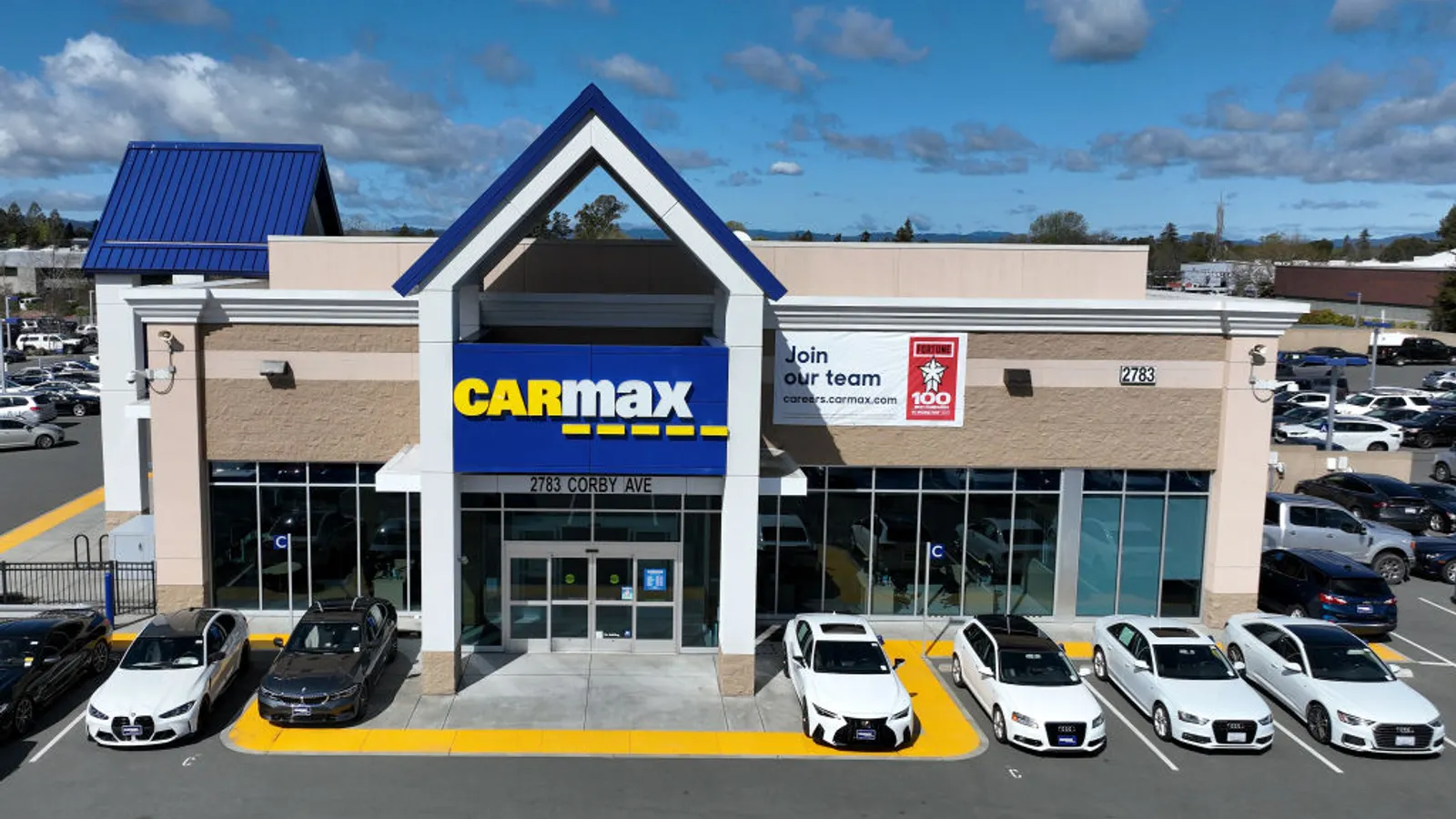


CarMax just told Wall Street it’s willing to make less money on every car it sells. On purpose.
The used-car giant reported first-quarter fiscal 2027 revenues of $8.0 billion, up 6.2% from a year ago, with combined retail and wholesale units climbing 3.3% to 392,357. The top line looks healthy. The margin line tells the real story: average gross profit per retail used vehicle fell nearly 10%, to $2,177.
That year-ago quarter was an all-time record, juiced by consumers panic-buying ahead of tariff fears. So some regression was inevitable. But CarMax isn’t just letting margins slip — it’s engineering the decline, deliberately shaving per-unit profit to keep sticker prices competitive and push volume higher.
This is the first strategic bet placed by Keith Barr, who took over as president and CEO on March 16 after spending more than 25 years running hotels at InterContinental Hotels Group. His first earnings call as the head of a 256-store used-car empire carried the energy of someone still learning the business but already rearranging the furniture.
Barr’s central insight so far: everything in auto retail is interconnected in ways the hospitality world never prepared him for. CarMax moves roughly 2 million cars a year — customer transfers, reconditioning shuttles, wholesale logistics. Trimming transportation costs doesn’t just save money in one line item; it ripples into pricing power, inventory velocity, and ultimately the customer’s willingness to buy.
“By reducing our cost in logistics, it underpins our ability to then remain competitive in pricing,” Barr said on the June 17 earnings call. He followed up the next day reiterating the point. He clearly wants analysts — and his own organization — to understand this isn’t a margin sacrifice. It’s a margin trade.
The playbook has four pillars. First, keep pricing aggressive across demand cycles while growing saleable inventory and getting cars in front of buyers faster. Second, stitch together digital and in-store experiences to improve conversion rates.
Third, push more loan originations through CarMax Auto Finance, particularly for near-prime borrowers currently being handed off to third-party lenders, and sell more extended-service contracts. Fourth, run lean — with an annual cost-cutting target now raised to $200 million in 2027, up from the earlier $150 million estimate.
That last number matters. CarMax is telling the market it plans to self-fund its pricing aggression through operational efficiency, not sustained margin compression. Barr was explicit: thinner per-unit profits are a short-term tactic, not the long game.
CFO Enrique Mayor-Mora backed the narrative. “We’re off to a really strong start for the year,” he said, pointing to first-quarter results as proof of concept.
The risk is obvious. A hotel executive running a used-car operation through a tariff-distorted market, voluntarily suppressing margins while promising future efficiency gains — that’s a story that works until it doesn’t. If cost cuts stall or the used-car market softens further, CarMax will have trained customers to expect lower prices without the operational savings to sustain them.
But there’s a logic to Barr’s approach that’s hard to dismiss. The used-car market remains fragmented, and CarMax’s scale advantage only compounds when volume grows. Every incremental unit sold feeds the finance arm, the service-contract business, and the reconditioning pipeline.
Margin per car is one metric. Margin per customer relationship is another entirely.
CarMax is betting it can shrink one number to grow the other. The next few quarters will tell us whether that’s strategic clarity or a newcomer’s expensive education.


Share this Story