
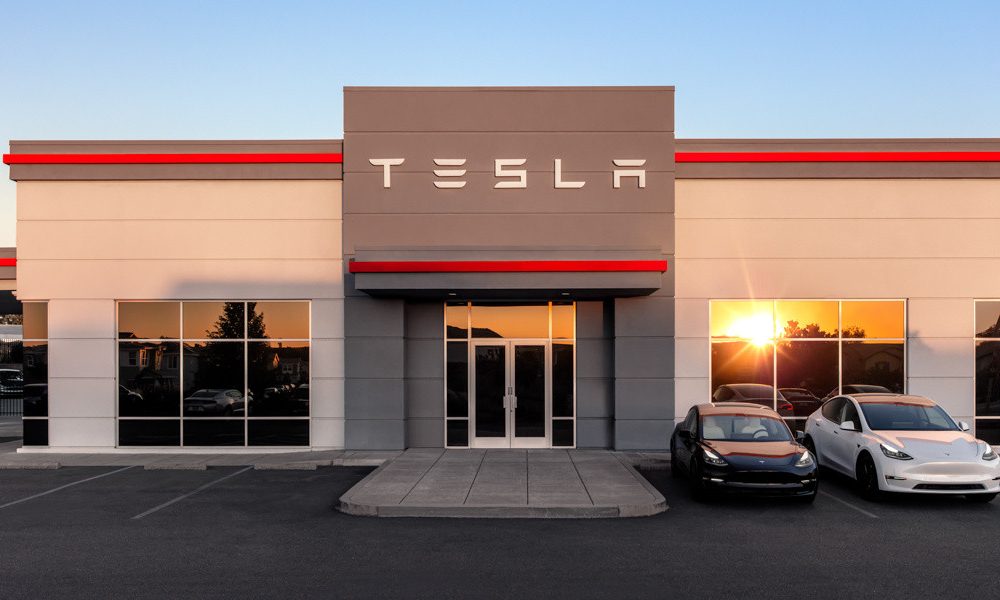


Tesla filed a trademark application for “MEGAPOD” with the USPTO, and the goods and services description reads less like an automaker’s filing and more like a hyperscaler’s product catalog. Serial number 99893717 covers modular data center hardware for AI computing — servers, networking gear, power distribution, cooling systems — all sold as self-contained units.
The filing, dated June 22, 2026, remains in live pending status awaiting assignment to an examining attorney. The language is precise enough to reveal Tesla’s intent: containerized, deployable AI compute pods designed to drop into locations far from traditional data centers.
This is not a battery product. Tesla already has the Megapack for utility-scale energy storage. MEGAPOD borrows the naming convention and the modular philosophy but applies it to a different market — distributed AI infrastructure.
The trademark also covers downloadable software for monitoring, managing, and optimizing those hardware systems. That suggests Tesla envisions selling these as turnkey platforms, not components.
The filing connects directly to plans Elon Musk outlined in March 2026 for “Digital Optimus,” the joint Tesla-xAI project aimed at deploying AI agents across Tesla’s physical footprint. That initiative calls for running inference workloads on parked vehicles using Tesla’s AI4 hardware and on dedicated compute units stationed at Supercharger locations. Those sites already have substantial electrical capacity sitting idle during off-peak hours.
A standardized, containerized compute pod solves an obvious problem with that strategy. Parking lots and charging stations don’t have server rooms. You need something self-contained — power, cooling, processing — that arrives on a truck and starts working.
The timing matters. Tesla and xAI have deepened their entanglement through the TERAFAB semiconductor facility in Austin and Tesla’s $2 billion investment in xAI. SpaceX completed its IPO earlier this month, giving Musk’s aerospace company public market currency for the first time. Wedbush analyst Dan Ives has pegged the odds of a Tesla-SpaceX combination at 80 to 90 percent by early 2027.
Against that backdrop, MEGAPOD looks less like a standalone product launch and more like infrastructure scaffolding for a much larger play. If Tesla, xAI, and SpaceX eventually converge under one corporate umbrella, distributed AI compute hardware becomes a connective tissue product. It could process autonomous driving data, run Grok inference locally, and support Starlink edge applications.
Tesla learned a hard lesson with the Cybercab name, which it failed to trademark early enough. The MEGAPOD filing suggests the company isn’t repeating that mistake. Securing the name now, before any product announcement, gives Tesla priority rights across the defined goods and services categories.
The AI infrastructure market is already crowded. Nvidia dominates GPU supply. Microsoft, Google, and Amazon are building data centers at furious scale, and CoreWeave went public specifically to finance GPU clusters.
Tesla entering this space with modular, distributed hardware rather than massive centralized facilities represents a different architectural bet. It leverages the company’s existing real estate, electrical infrastructure, and manufacturing capability.
Whether MEGAPOD ships as a commercial product sold to third parties or remains an internal deployment tool, the trademark filing confirms something the company’s financials have been hinting at for two years. Tesla increasingly sees itself as an AI infrastructure company that happens to make cars.
The examining attorney hasn’t even been assigned yet. But the strategic direction is already locked in.

Share this Story