
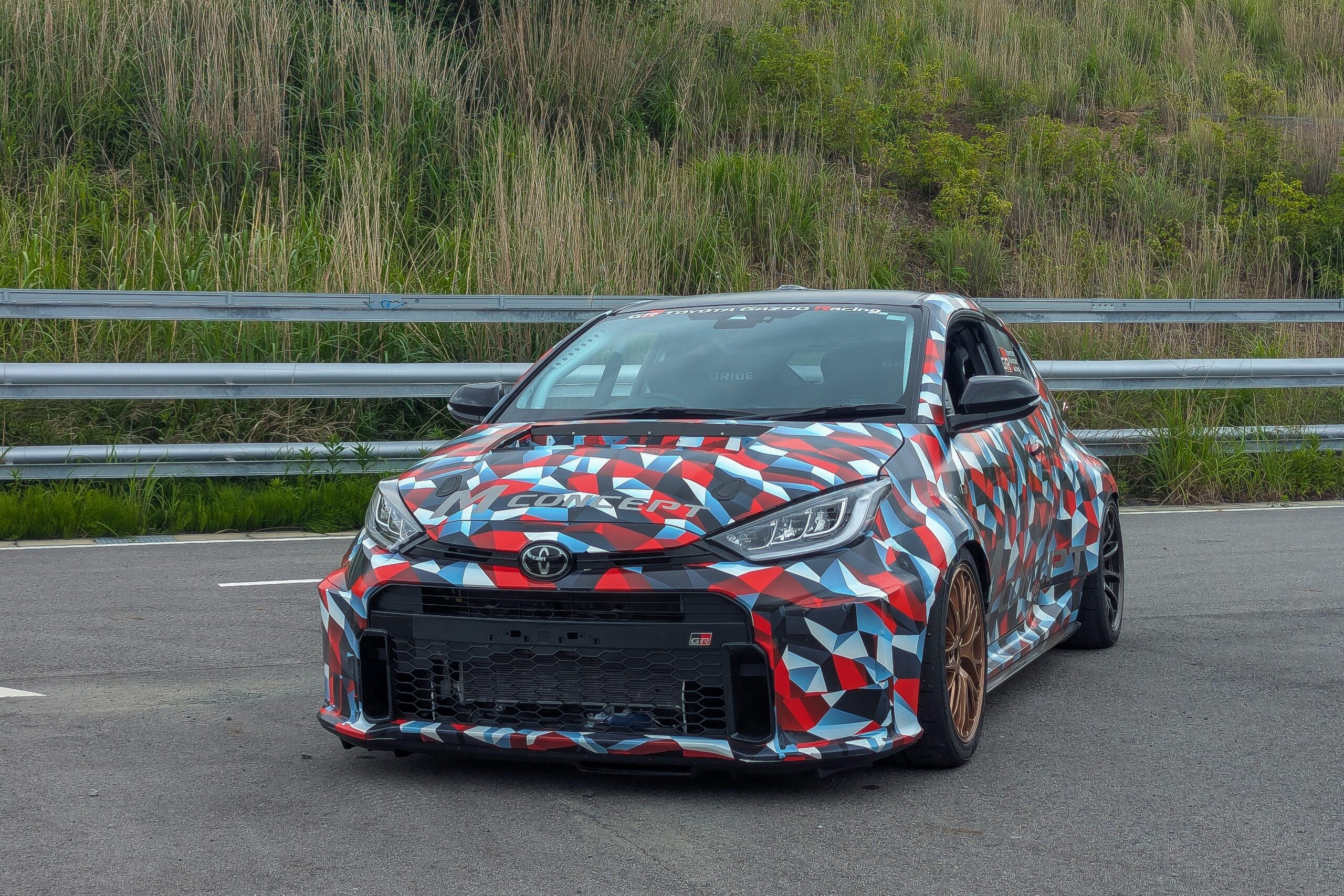


Twenty minutes. That’s how long you can drive Toyota’s mid-engine M Concept prototype before it overheats. And Toyota invited journalists to drive it anyway.
That tells you everything about where this program stands and how badly Gazoo Racing wants you to care about it.
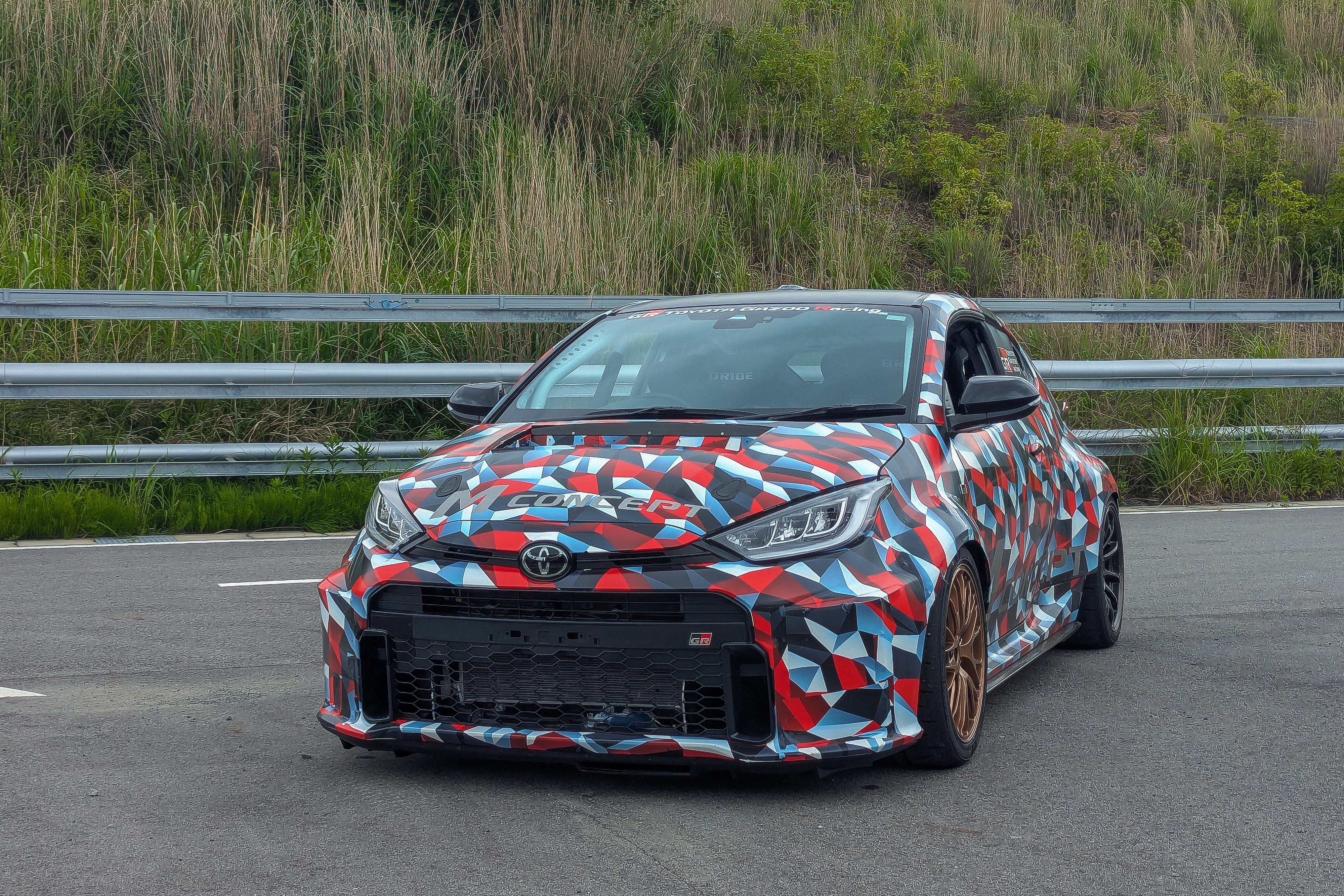
The M Concept is a gutted, roll-caged, permanently-markered GR Yaris with its engine ripped from the front and stuffed behind the driver. Akio Toyoda’s signature is scrawled on the windshield. Random patches of tape and mystery buttons dot the interior.
It looks, by Toyota’s own admission, like a rolling nightmare of ideas. And it might be the embryo of a reborn MR2.
GR chief engineer Naohiko Saito confirmed six iterations of the mid-engine, all-wheel-drive test bed currently exist, with at least 14 more planned. Around 500 Gazoo Racing employees are working on the project. “These are our toys,” Saito said, though toys with mismatched wheels, intercoolers poking through carbon-fiber roofs, and swollen quarter-panels hiding additional cooling radiators.
Under the now-empty front hood sits a GR Yaris rear subframe and differential, rotated 180 degrees. A prop shaft runs from the rear-mounted transmission forward. The result is an inverted version of the GR Corolla’s drivetrain, still all-wheel drive with front and rear Torsen limited-slip differentials, but with a 30/70 front-to-rear torque split as the baseline.
Engineers tested 70/30 but scrapped it because of understeer, which Toyoda has memorably described as “time to pray to God.”
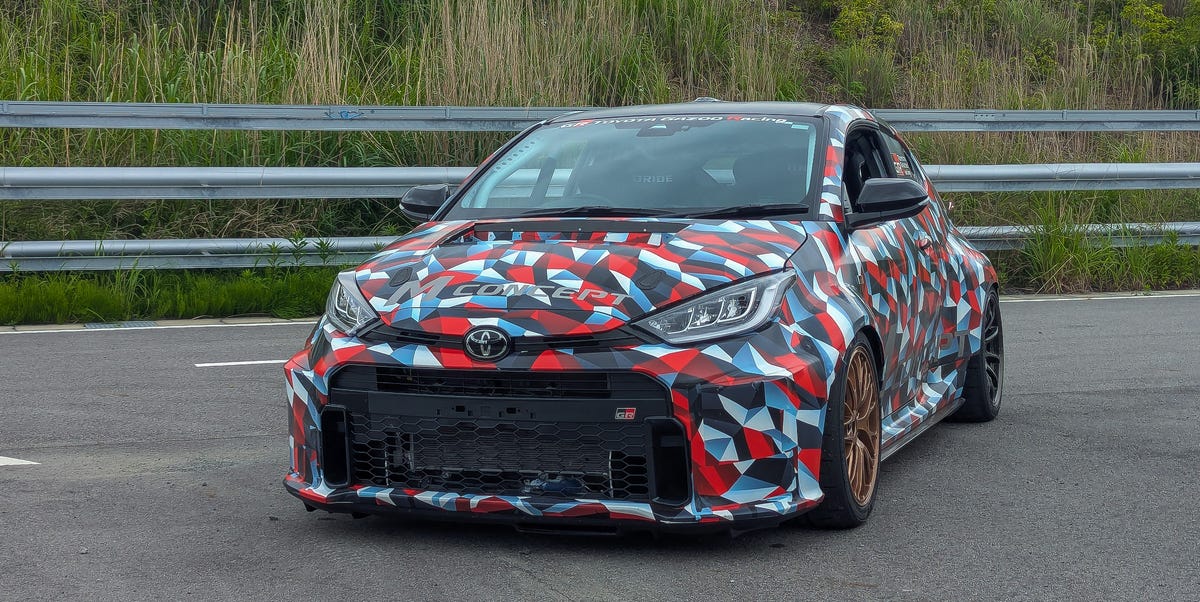
The early car uses the GR Yaris’s 1.6-liter turbo three-cylinder. It felt unremarkable on gravel at Toyota’s Shimoyama proving grounds, hampered by heat soak and heavy rally rubber. But the chassis rotated with almost no effort.
Lift, pin, slide. On loose surfaces it felt closer to a Lancia Stratos than anything else in Toyota’s current lineup.
The real fireworks came in a fifth-generation mule powered by the new G20E, a 2.0-liter twin-scroll turbocharged inline-four with dual overhead cams, 16 valves, and both port and direct injection. Every turbo visible on the mules dwarfed the IHI unit in current GR products. On Toyota’s 3.3-mile Nürburgring-inspired test loop, where a 300-horsepower GR Yaris hit 75 mph, the M Concept reached nearly 100.
Toyota’s professional driver attacked corners with deliberate oversteer rather than fighting understeer. Loud exhaust pops cracked between shifts. The message was unmistakable: this powertrain is being developed to exceed 100 horsepower per cylinder, and Toyota wants you to hear every bit of it.
The latest Gen-6 race version just competed in the 24-hour Super Taikyu race at Fuji Speedway, lapping within one second of established GT4 machinery. It also cracked an oil cooler and snapped a wastegate rod. Race, break, learn, repeat — that’s the stated philosophy.
The race car’s chassis is stretched 3.9 inches over the GR Yaris, pushing the engine farther rearward. It runs staggered wheels — 260-section fronts, 300-section rears — with two-piece rotors and four-piston calipers out back. Whether any of that reaches production is anybody’s guess, because Toyota isn’t confirming what this becomes.
MR2, Celica, something entirely new — Saito wouldn’t say.
What he would say is that failures have been constant. “Too much to list,” he admitted. “Sometimes when you change one thing, something else bad can happen.”
Toyota deliberately showed this car while it’s still raw, ugly, and thermally challenged. No sheet pull, no polished reveal, no marketing choreography. Just a half-finished mid-engine project car that slides beautifully and breaks regularly.
The whole program feels modular enough to spawn multiple vehicles, but one thing is already clear: Gazoo Racing is building something that combustion enthusiasts have been begging for, and they’re doing it with the kind of reckless transparency that makes the rest of the industry’s teaser campaigns look sterile. Don’t expect a finished product before 2027 at the earliest. Do expect Toyota to keep breaking things loudly until then.


Share this Story