
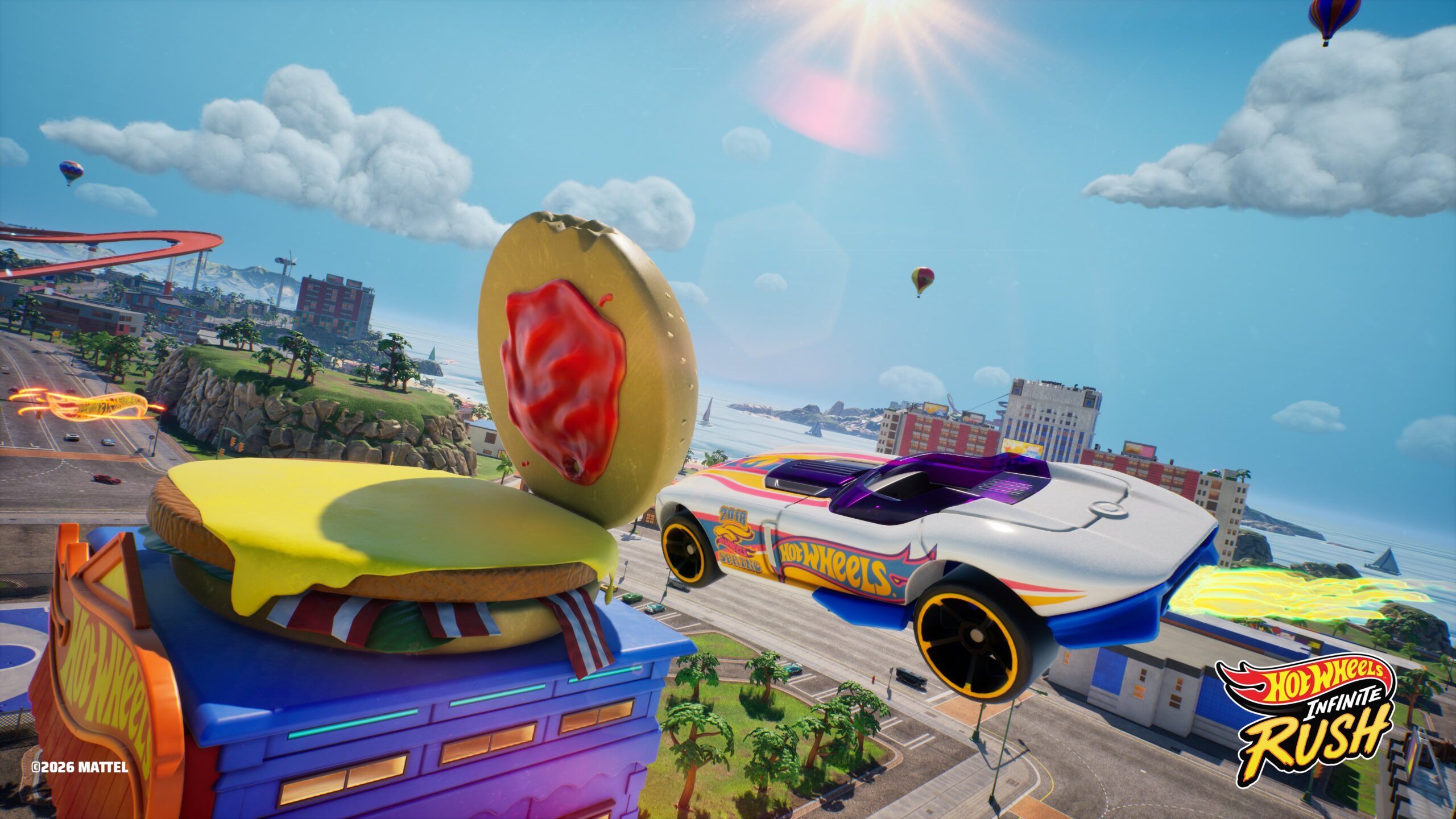


Milestone has been quietly building a case as the most interesting arcade racing studio working today. Fresh off the well-received Screamer, the Italian developer is now turning its Hot Wheels license into something genuinely ambitious. Hot Wheels Infinite Rush drops the linear playsets of the Unleashed games in favor of four open-world environments, and based on a recent hands-on preview, the pivot looks like it’s paying off.
The game launches September 24 on PS5, Xbox Series X and S, Nintendo Switch 2, and PC at $50. That price point alone says something about where Milestone is aiming.
A roster of 150 die-cast vehicles splits across four classes: Versatile, Speeder, Drifter, and Titan. Each earns boost differently depending on driving style, a mechanic lifted straight from the Burnout Paradise playbook. Mixed into the fictional Hot Wheels designs are Mattel-fied versions of real metal, including the Ferrari SF90 Stradale, Lancia Delta Integrale, NA Mazda Miata, and Mitsubishi Pajero Evolution.
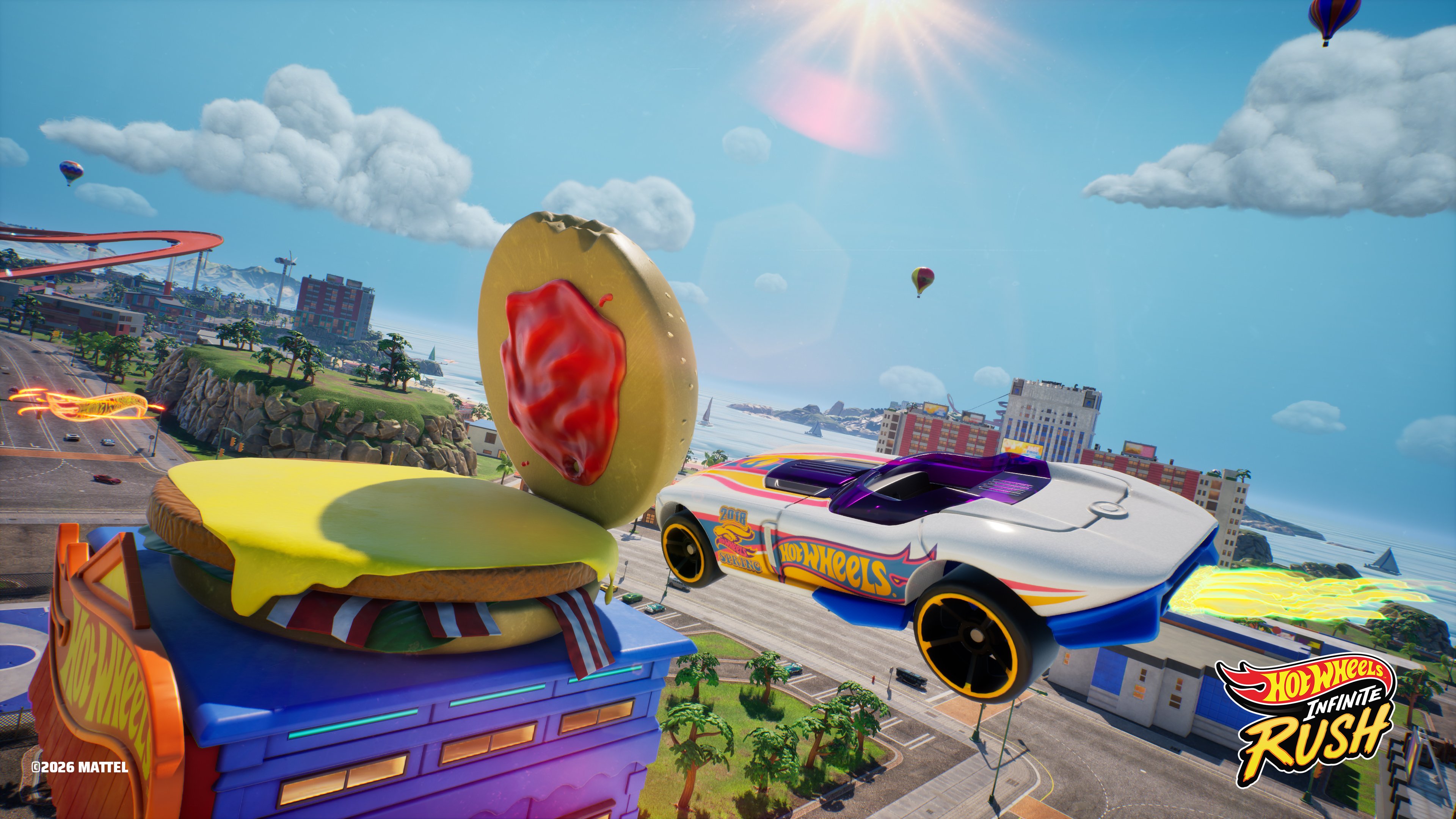
The cars themselves are visual standouts. Milestone’s command of Unreal Engine turns every vehicle into a miniature sculpture with metallic flake paint, printed tampo graphics, and plastic wheels that look like they just rolled out of a blister pack. Performance on a midrange PC reportedly held steady at high settings with minimal loading screens.
The open-world structure borrows freely from the Lego 2K Drive template. Swap one beloved toy franchise for another and the vibe is nearly identical: miniature cities packed with secrets, collectibles, and events scattered across the map. One environment called Wheelswood features grid streets, mountain roads, and those unmistakable orange and blue tracks with massive loops suspended overhead.
What separates Infinite Rush from just another collect-a-thon is the Daredevil mechanic. Rival cars roam the open world, and driving near one triggers an instant head-to-head race. Beat them and they join your collection. Lose and they powerslide away, taunting you until the next encounter. It’s the kind of organic, low-friction challenge design that even Forza Horizon’s event system can’t quite match.
Players will also be able to build custom tracks within the open-world maps, adding a creative layer that could stretch the game’s life well past launch.
The driving physics aren’t flawless. There’s a heaviness and understeer at low speeds that plagues a lot of modern arcade racers, a design choice that favors long drifts over razor-sharp responsiveness. The Drifter-class vehicles lean hardest into this philosophy. It works, mostly, but drivers who prefer snappy inputs will feel the compromise.
Milestone’s earlier Unleashed titles suffered from stiff handling and forgettable track layouts. Breaking free of scripted courses appears to have solved the second problem, and the variety of vehicle classes at least addresses the first. When you clip a lamp post, there’s a plastic popping sound, the kind of small detail that proves the developers understand they’re making a toy car game, not pretending otherwise.
The obvious comparison is to Forza Horizon’s past Hot Wheels and Lego expansions, which were entertaining diversions but ultimately thin. Infinite Rush already appears to offer more depth and more reason to keep exploring than either of those add-ons delivered as standalone content.
This is a game aimed squarely at younger players and the adults who never stopped playing with die-casts. Milestone isn’t trying to compete with Forza Horizon 6 head-on. They’re building something adjacent to it, more colorful, less serious, and potentially more fun in short bursts.
At $50, with 150 vehicles and four open worlds at launch, the value proposition is hard to argue with. Whether Infinite Rush can sustain that momentum past the first few hours will depend on how well its open worlds hold up to repeated exploration. But Milestone has earned enough goodwill this year to deserve the benefit of the doubt.
Share this Story