
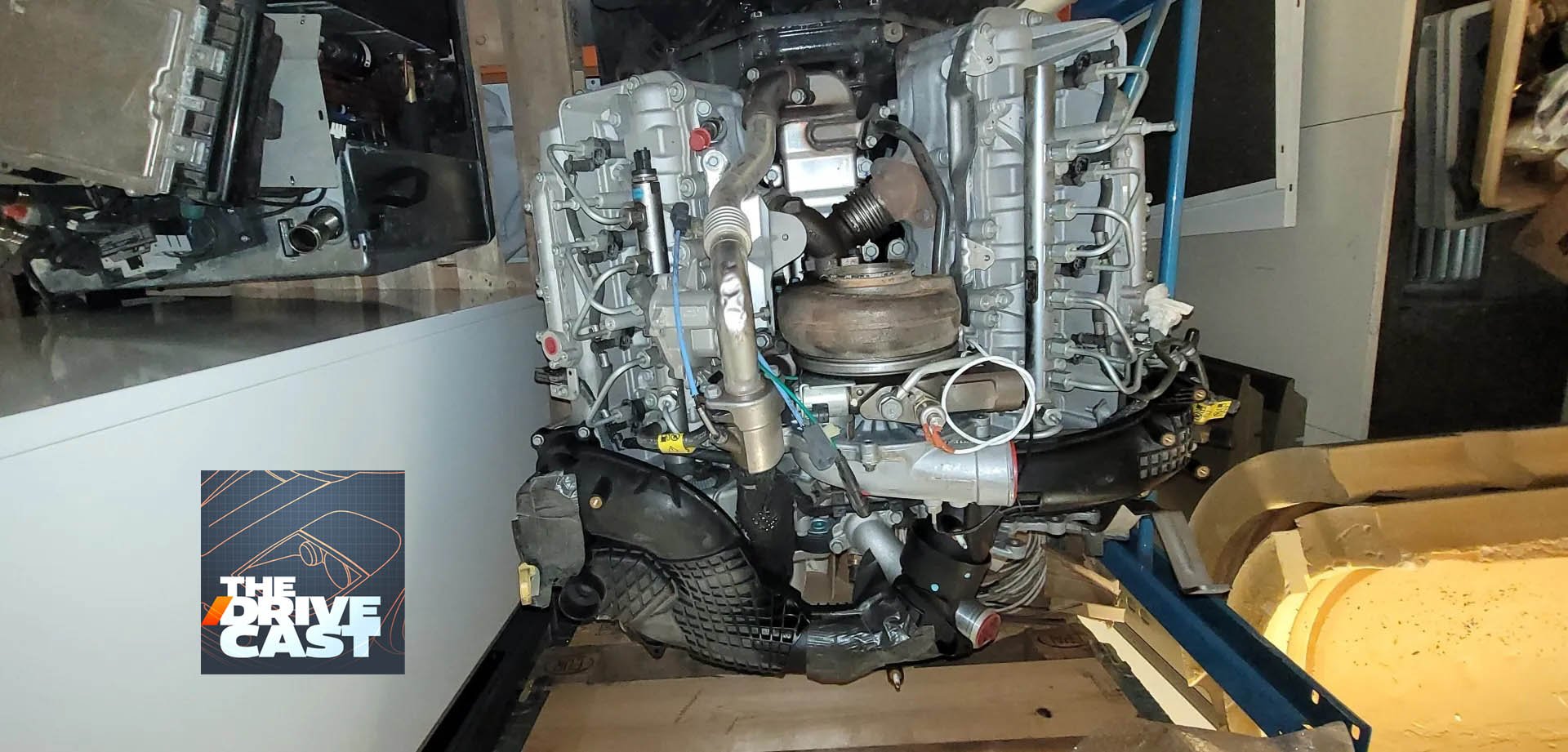


General Motors swore it destroyed every prototype of the 4.5-liter turbodiesel V8 known internally as the LMK, the so-called Baby Duramax. At least one made it out alive. It’s sitting in a garage in Sweden, owned by a diesel enthusiast named Henrik who bought it as part of a bulk engine deal and didn’t even know what he had at first.
The Drive’s Caleb Jacobs tracked down the engine after months of reporting that reads more like an investigative thriller than a powertrain story. A Facebook Marketplace seller initially surfaced with what appeared to be LMK prototypes, then scrubbed every message and photo after learning a journalist was on the other end. Then Henrik reached out from across the Atlantic, photos in hand, and suddenly the myth had proof.
The Baby Duramax was no ordinary truck engine. Developed in the mid-2000s, it was a compact turbodiesel V8 designed to drop into any application that accepted GM’s venerable small-block — Silverado, Tahoe, Suburban, Escalade, Yukon. It made 520 pound-feet of torque, more than any half-ton competitor at the time and a figure that still tops modern light-duty diesels nearly two decades later.
Its most radical feature was a hot-V turbocharger layout, placing the turbo between the cylinder banks. That architecture didn’t appear in production sports cars for another decade, showing up in Mercedes-AMG GTs and the unicorn-rare Cadillac CT6-V Blackwing. GM had it working in a truck engine around 2007.
Gale Banks, the legendary diesel tuner, saw the engine firsthand. GM invited him to evaluate it for potential marine applications — inboard boat engines often run modified automotive powerplants. When Jacobs called Banks for the story, the old master pulled out handwritten notes from 20 years ago. His impressions confirmed what the spec sheet promised: this was a genuine leap, not a marketing exercise.
The engine was shown publicly at least once, installed in a Suburban concept at SEMA. It was close to production. Then Lehman Brothers collapsed, credit markets froze, and GM filed Chapter 11 in June 2009.
Had it survived, the ripple effects are hard to overstate. A 520 lb-ft diesel in a half-ton would have forced Ford and Ram into a response years before Ram eventually launched its 3.0-liter EcoDiesel in 2014, an engine that made considerably less torque. The technology would have filtered into full-size SUVs, potentially reshaping fuel economy across GM’s most profitable fleet. It might have delayed or altered the trajectory toward electrification.
Instead, we got the timeline we’re living in now. GM is selling the Silverado EV Trail Boss with 775 pound-feet of electric torque and a battery pack that makes the truck weigh roughly 8,000 pounds. The irony is thick.
Henrik still has the engine and still wants to sell it. One prospective buyer wanted to drop it into a square-body Chevy, but couldn’t find a shop willing to tackle the conversion. Understandable, given the complexity of late-2000s diesel emissions hardware and the total absence of production calibration data.
So the Baby Duramax sits, a piece of automotive history in a country that had nothing to do with its creation, proof that GM’s crusher wasn’t as thorough as advertised. The question nobody at GM seems eager to answer: if one got out, how many more are hiding?


Share this Story