


For a company that sells ten million vehicles a year, Toyota has spent a surprising amount of energy lately trying to convince the world it thinks about one person at a time.
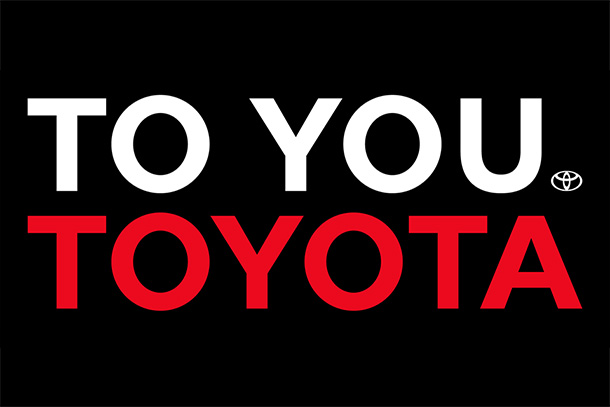
The Japanese automaker launched a new brand concept in autumn 2025 called “TO YOU,” accompanied by a freshly minted special site explaining the philosophy behind it. It arrives alongside a broader corporate restructuring that elevates Century to a standalone brand and clarifies the identities of Lexus, GR, and Daihatsu under distinct taglines. Toyota, the mothership badge that accounts for the vast majority of the company’s global volume, gets two words and a period.
The pivot is subtle but deliberate. “Mobility for All,” the corporate vision Toyota has leaned on for years, isn’t being retired. It’s being repositioned as the umbrella over the entire group, including Lexus and Century.
TO YOU” is supposed to be different — the specific promise of the Toyota brand itself, the one on the grille of every Corolla, Hilux, and Land Cruiser rolling off a line somewhere on six continents.
Toyota explains the distinction with a question that’s more revealing than it probably intended: does designing “for all” really mean designing for the average? The company’s own answer is no. It points to the original Prius, which in 1997 was emphatically not a car for everyone.
It was polarizing, odd-looking, and aimed at a narrow slice of true believers. Three decades later, it’s an icon. The lesson Toyota draws is that meaning something to someone beats meaning nothing to everyone.
That’s a fine bit of corporate philosophy. It’s also a convenient framework for a company selling gasoline trucks in sub-Saharan Africa, plug-in hybrids in California, and kei cars through Daihatsu in Osaka — all while competitors sharpen their EV-or-nothing messaging. Toyota has long been criticized for hedging on electrification, and framing its multi-powertrain strategy as individualized care rather than strategic indecision is a neat trick.
The “TO YOU” site leans heavily on two examples. First is Corolla, which Toyota describes not as a universal car but as a chameleon — sedan here, hatchback there, hybrid in one city, pure gasoline in another. The second is the IMV Origin, a vehicle under development for Kenyan buyers, designed to be shipped as a near-complete kit and assembled locally.
Seats fold to make room for cargo. The truck isn’t transport; it’s livelihood. Toyota frames this as empathy, but it’s also a proven business model for emerging markets where local assembly dodges import tariffs and creates jobs that build brand loyalty deeper than any ad campaign.
The origin story gets hauled out too. Sakichi Toyoda built his first loom to ease his mother’s daily labor. One person, one problem, one solution.
Then a jump to 2009, when Akio Toyoda took the helm and declared the company had lost its way chasing volume. “Let’s make ever-better cars,” he said. That mantra carried Toyota through fifteen years of record profits and the largest production numbers in the industry.
Now the company wants “TO YOU” to carry the next chapter. Century gets “One of One.” Lexus gets “Discover, Imitate no one.” GR gets “THE SOUL LIVES ON.”
Each tagline maps cleanly to a customer. Toyota’s own tagline is the vaguest of the five — deliberately so, because the brand has to stretch from a $20,000 sedan to a lunar rover concept without snapping.
Whether “TO YOU” changes anything on the factory floor or in the showroom is the real question. Toyota is still building every powertrain type, still resisting the full-EV pivot its European and Chinese rivals have embraced, still betting that the world is too varied for a single answer. The philosophy isn’t new, but the branding is.
And branding, in Toyota’s case, has always followed the engineering — not the other way around. Two words won’t quiet the critics. But ten million vehicles a year buys you the right to define your own terms.

Share this Story