



U.S. tariffs have now drained at least $35.4 billion from automakers since taking effect, according to an Automotive News analysis. That number alone is staggering. The distribution of the pain is even more telling.
Toyota bears the heaviest single burden at $9.1 billion. That’s more than GM, Ford, and Stellantis combined, which together account for an estimated $6.5 billion. The Japanese giant’s massive global supply chain, with vehicles and parts flowing across borders from Japan, Canada, and Mexico, makes it uniquely exposed.
Consider the math. Toyota runs assembly plants across North America, including a major Highlander operation in Indiana. But the components feeding those lines come from everywhere, and every border crossing now carries a tax.
The company that perfected lean manufacturing and just-in-time logistics is getting punished precisely because of its global efficiency.
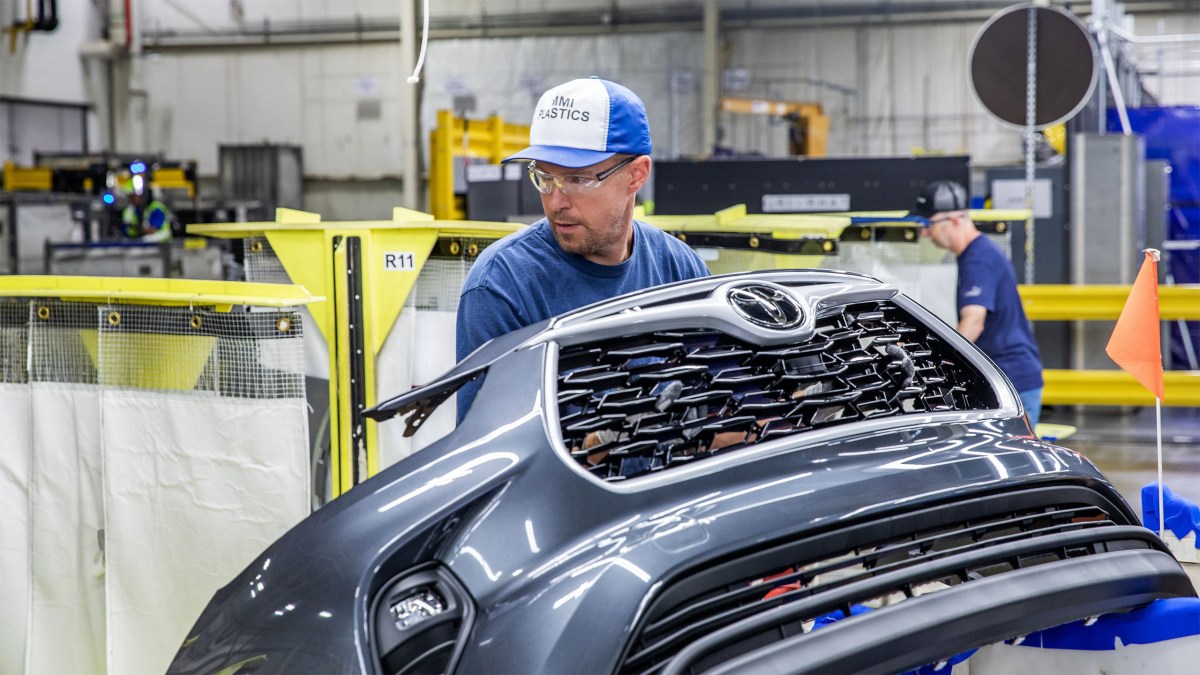
Detroit’s Big Three aren’t escaping unscathed, but their relatively lower combined figure reflects decades of shifting production onto American soil—a strategy born less from patriotism than from previous rounds of trade pressure dating back to the 1980s. History rhymes. Toyota and other foreign-nameplate manufacturers built U.S. plants for the same reasons, but their parts pipelines remain far more internationally entangled.
The $35.4 billion figure represents costs already absorbed, not theoretical projections. These are real dollars pulled from balance sheets, and they inevitably flow downstream. Consumers won’t see a line item called “tariff surcharge” on their window stickers, but the pressure has to go somewhere—into thinner margins, deferred investment, reduced incentives, or higher transaction prices.
Meanwhile, Toyota is simultaneously dealing with a recall of more than 500,000 Highlander and Highlander Hybrid SUVs from 2021 through 2024 over rear seats that may not lock properly. The Highlander, built in Princeton, Indiana, is one of Toyota’s core American-market products. Absorbing a $9.1 billion tariff hit while managing a half-million-unit recall on one of your highest-volume models is not a good quarter.
Across the industry, the Federal Trade Commission fired a warning shot at 97 dealer groups late last week, reminding them that advertised prices must include all mandatory fees, be available to every customer, and actually exist. As tariff costs push real prices higher, the temptation for dealers to play games with advertised numbers grows. The FTC apparently sees it coming.
Honda, for its part, pushed back on reports that it plans to kill Prologue EV production in December. “The article is based purely on speculation,” Honda told Motor1. But in an environment where every imported component costs more and EV margins are already razor-thin, skepticism about the Prologue’s long-term viability isn’t unreasonable.
The tariff toll reshapes the competitive landscape in ways that won’t be obvious for months. Toyota’s outsized exposure could slow its investment in electrification, autonomous tech, or next-generation models. GM and Ford, lighter on tariff burden, may find a rare window of relative advantage against their largest rival—not because they built better cars, but because trade policy tilted the floor.
Thirty-five billion dollars doesn’t vanish. It gets absorbed, redistributed, and eventually passed along. The only question is how much pain lands on the companies and how much lands on the people signing loan papers at the dealership. Based on three decades of watching this industry, the answer is almost always the latter.




Share this Story